
AI INFRASTRUCTURE · U.S. LOCATION STRATEGY
How AI Is Redefining Data Center Site Selection
AI data center site selection starts with the workload: the power, cooling, network, space, and delivery conditions needed to support the proposed computing systems.
A strong location strategy connects the first deployment with a credible path for changing equipment, additional capacity, and long-term operations.
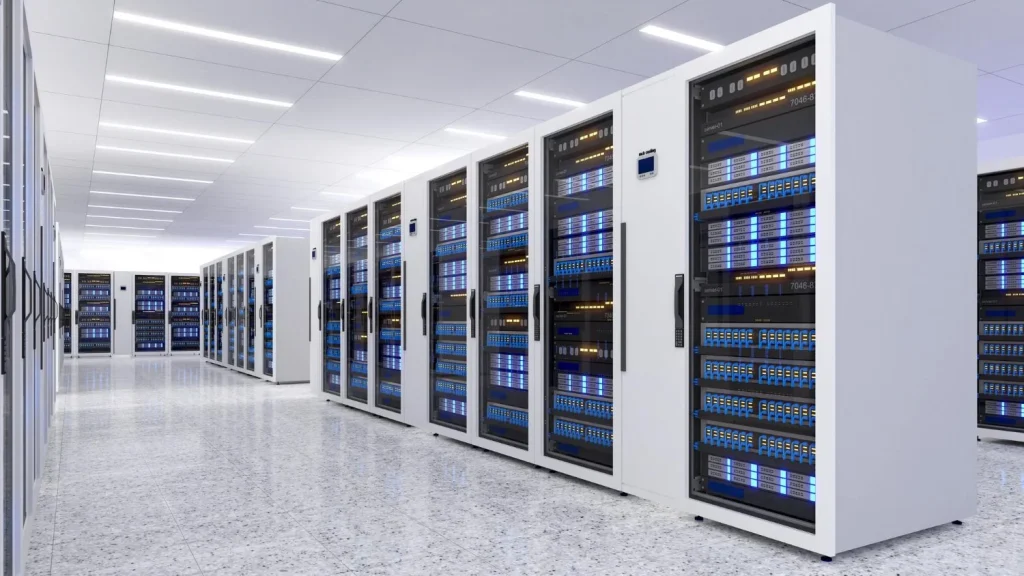
Data center interior image, shown for context. Actual infrastructure requirements depend on the equipment and workload.
BEGIN WITH WHAT THE COMPUTING MUST DO
AI projects do not share one location brief.
Training, inference, high-performance computing, and mixed enterprise operations can place different demands on a facility. Some projects combine them. Define the application’s performance, reliability, data movement, and growth requirements before ranking markets.
| Illustrative deployment | Priorities to investigate | What that means for the location review |
|---|---|---|
| Training-focused infrastructure | Accelerator configuration, cluster networking, storage access, power profile, and heat removal. | Test the engineering design, deliverable services, equipment layout, and schedule as one deployment plan. |
| Latency-sensitive inference | Response-time objectives, demand patterns, data access, network paths, and service availability. | Measure performance to the intended users and systems; compare connectivity and resilience alongside power and cooling. |
| Mixed enterprise and AI use | Shared infrastructure, localized rack densities, operating continuity, and room for changing workloads. | Assess the specific zones and systems being added, including retrofit constraints and the effect on existing operations. |
These are planning examples, not fixed siting rules. Use the data center site selection guide as the broader framework, then adapt it to the proposed systems.
POWER / MATCH THE SERVICE TO THE LOAD
Capacity, load behavior, and delivery timing belong together.
Have engineers define the IT equipment demand, total facility electrical demand, expected peaks, operating behavior, and phased growth. Give the serving utility a clear planning baseline and update it when the design changes.
Confirm the actual service
Review the proposed site, service arrangement, reliability requirements, and network improvements. Regional supply statements still need a project-specific provider assessment.
Build a phased delivery plan
Separate service for commissioning, initial operations, and later loading. Track studies, rights-of-way, equipment, approvals, construction, and customer responsibilities.
Keep assumptions visible
Record which dates and capacities are indicative, studied, conditional, or committed under the relevant documents. Identify the events that could change them.
The IEA’s energy and AI analysis highlights grid connections, equipment supply, and other deployment constraints. That market context strengthens the case for early verification; it does not establish a service date for an individual property.
Continue with how to evaluate data center power capacity.
COOLING / FOLLOW THE SELECTED HARDWARE
Translate rack density into a complete cooling brief.
Define the engineering requirements
Ask the design team to establish heat loads, temperatures, airflow or liquid-cooling needs, electrical overhead, water requirements, equipment space, and maintenance access. Review seasonal performance and later equipment changes.
The selected cooling and heat-rejection approach determines the resource questions. A general “AI-ready” or “liquid-cooled” label does not quantify the site’s water demand.
Test the actual configuration
Confirm the utility supply, water quality, discharge conditions, plant footprint, and operating limits that follow from the design. Include the space and service needs of future phases.
For a concrete manufacturer example, NVIDIA’s DGX B300 deployment guidance (PDF) describes different density and cooling configurations. Apply the requirements of the equipment actually selected, rather than treating one example as an industry-wide specification.
Use water availability analysis to connect the engineering assumptions to the location’s resource conditions.
CONNECTIVITY / REVIEW BOTH SIDES OF THE NETWORK
Cluster design and external fiber answer different questions.
Inside the facility or campus
The compute, storage, and network design can affect rack placement, cable paths, distances, equipment space, and service access. Have the technical team validate the proposed layout against the chosen architecture.
A building that appears spacious can still need changes to support the required configuration.
Beyond the property
Confirm carrier services, capacity, physical routes, site entries, extension work, and delivery dates. Test the network paths to the applications, users, cloud regions, and data sources that matter.
Review shared infrastructure and failure points with network specialists. Multiple carrier names alone do not demonstrate physical route diversity.
The location’s network value depends on the workload’s actual performance and resilience requirements. Keep those requirements consistent when comparing sites.
LAND AND BUILDINGS / RESERVE THE OPERATING FOOTPRINT
Plan the infrastructure around the computing.
Usable space
Allow for electrical and cooling systems, access, security, stormwater, equipment clearances, and supporting facilities. Map constraints against a workable layout.
Deployment logistics
Review heavy equipment routes, loading, staging, lifting, floor capacity, internal movement, and maintenance or replacement access with the appropriate specialists.
향후 단계
Protect practical locations for additional buildings, utility infrastructure, cooling equipment, and network corridors. Confirm how expansion can coexist with an operating phase.
For an existing facility, assess the proposed AI installation against the systems and operating conditions already in place. For a new campus, connect the layout to actual service delivery and approval pathways.
Explore planning data center sites for future campus expansion.
PEOPLE AND APPROVALS / PLAN FOR IMPLEMENTATION
Infrastructure needs people and a workable local pathway.
Build the delivery and operations team
Evaluate access to construction trades, commissioning specialists, electrical and mechanical support, controls, network expertise, and facility operations talent. Confirm the roles and availability the deployment plan assumes.
Training, vendor support, housing, commuting, and relocation can affect whether a staffing plan is practical.
Engage the relevant authorities early
Review the proposed use, buildings, utility works, cooling plant, backup generation, noise, water, and other applicable matters with the appropriate authorities and specialists.
Connect environmental and site findings with design, community engagement, costs, and the schedule. Requirements depend on the project and jurisdiction.
Review the data center site readiness checklist to turn broad development claims into a defined scope of work.
THE AI DATA CENTER LOCATION EVIDENCE MATRIX
Compare every finalist against the same operating plan.
Use consistent definitions, assumptions, and dates. Show both the strength of the fit and the confidence of the evidence.
| Decision area | 요청할 증거 | Question for the decision team |
|---|---|---|
| Workload and hardware | A documented application brief, selected configuration, design assumptions, and growth cases. | Does this location support the operation being planned? |
| Power | Provider assessment, phased service scope, dependencies, costs, and relevant terms. | Can the required service support each intended milestone? |
| Cooling and resources | Engineering basis, resource demand, supply conditions, and seasonal assumptions. | Can the design operate within the location’s real constraints? |
| Connectivity | Technical architecture, carrier plans, physical routes, capacity, and performance requirements. | Do the internal and external networks meet the workload’s needs? |
| Property and approvals | A workable layout, technical studies, approval matrix, access plan, and expansion scope. | What must be changed, authorized, or delivered before use? |
| Economics and timing | Comparable cost models, incentive conditions, delivery schedules, and scenarios. | Does the operating case remain workable when important assumptions change? |
The changing data center site selection guide places these priorities in the wider location market.
STRESS-TEST THE BUSINESS CASE
Compare the cost of the operating outcome.
Include property, fit-out, utility work, cooling infrastructure, network extensions, equipment installation, labor, ongoing services, and lifecycle needs. Model incentives separately so their conditions and timing remain visible.
Power arrives differently
What changes if initial service is available but a later phase moves? Revisit deployment sequencing, equipment commitments, revenue assumptions, and the practicality of any interim plan.
The hardware changes
What happens if the selected systems need a different electrical arrangement, heat-removal design, floor capacity, or layout? Identify the cost and schedule consequences.
Demand grows differently
Can the site accommodate a faster ramp, a slower ramp, or a different workload mix? Test which infrastructure commitments remain useful under each case.
These are illustrative planning scenarios. Assign the assumptions, evidence, response, and owner for each one. Continue with hidden data center site costs and incentives planning.
FROM LOCATION SCREENING TO DEPLOYMENT
Keep the technical plan and location decision connected.
1 · Define the brief
Align application owners, engineering, IT, operations, finance, and leadership around the workload, configuration, demand, reliability needs, schedule, and growth assumptions.
2 · Validate the shortlist
Obtain appropriate provider responses, technical studies, authority input, and cost information. Identify the material gaps in each candidate’s delivery plan.
3 · Decide with conditions
Document the preferred option, alternatives, evidence, unresolved issues, and approval conditions. Confirm which commitments depend on further validation.
4 · Carry the findings into execution
Transfer provider obligations, technical requirements, approvals, milestones, and open issues into implementation planning. Revisit the plan when the requirements change.
A coordinated process connects the first operating phase with later capacity. WorldPoint’s project management collaboration supports alignment across the relevant workstreams.
COMMON QUESTIONS
AI data center site selection FAQs
How is AI changing data center site selection?
AI workloads can change rack density, electrical demand, cooling, network design, equipment space, and deployment needs. The location review should follow the planned configuration and workload, then verify the infrastructure and delivery conditions at each site.
Do training and inference projects need the same location?
Their priorities can differ, and some deployments combine both. Define the actual performance, latency, data movement, availability, scale, and cost requirements before deciding which locations fit.
Do all AI data centers require liquid cooling?
No single cooling approach fits every configuration. Hardware, density, workload, environment, and engineering design determine the requirements. Confirm the selected equipment’s needs and the resources required by the cooling and heat-rejection systems.
Is a large power allocation enough to make an AI site viable?
Review the proposed service, load profile, phase timing, reliability needs, required improvements, and conditions. The location also needs appropriate cooling, connectivity, space, approvals, access, and an achievable implementation plan.
Can an existing data center support AI workloads?
Assess the proposed installation against the existing electrical, cooling, network, structural, and operating conditions. Identify modifications, constraints, service impacts, and the requirements of future equipment before relying on available floor space.
Why does fiber route diversity matter?
The intended resilience depends on physical paths and shared infrastructure, along with service arrangements and technical design. Have network specialists examine route and entry information against the project’s availability requirements.
What should be confirmed before choosing finalists?
Confirm the workload brief, design assumptions, service scope, provider dependencies, cooling resources, network requirements, property fit, approval pathway, economics, and growth options. Make unresolved issues and evidence confidence visible.
How can a site support future AI equipment changes?
Protect adaptable electrical and cooling infrastructure, practical space, maintenance access, network paths, and expansion corridors. Test credible future configurations with engineers and providers rather than assuming spare land creates usable capacity.
TECHNICAL REFERENCES AND NEXT READING
Use research to inform the questions. Validate the actual site.
The IEA energy and AI report provides market context. NVIDIA’s DGX B300 guidance (PDF) illustrates configuration-specific deployment planning. The Department of Energy’s data center design guide (PDF) covers related IT, electrical, and cooling decisions.
The comparisons and scenarios in this article are a planning framework. Apply current engineering, provider, authority, and operating information to the proposed project.
월드포인트 부지 선정
Build an AI location strategy around the operation.
WorldPoint helps data center and industrial leaders connect infrastructure, workforce, economic development coordination, incentives, relocation, and long-term operating needs in one U.S. location decision.
Bring your starting assumptions
Share the workload, hardware direction, initial and future demand, cooling concept, network needs, target milestones, and locations under consideration. Those inputs help define the questions that matter most.
Qualified specialists perform the appropriate technical, environmental, legal, and other reviews. WorldPoint provides advisory services; brokerage activities, when needed, are handled separately through CBREG True Team.