
MANUFACTURING EXPANSION · TIME TO MARKET
How Manufacturing Site Selection Affects Time to Market
Choose a location with a credible path from site decision to qualified production—and the people, utilities, and suppliers to sustain it.
Von Hunter Drinkall · Veröffentlicht am 9. September 2026
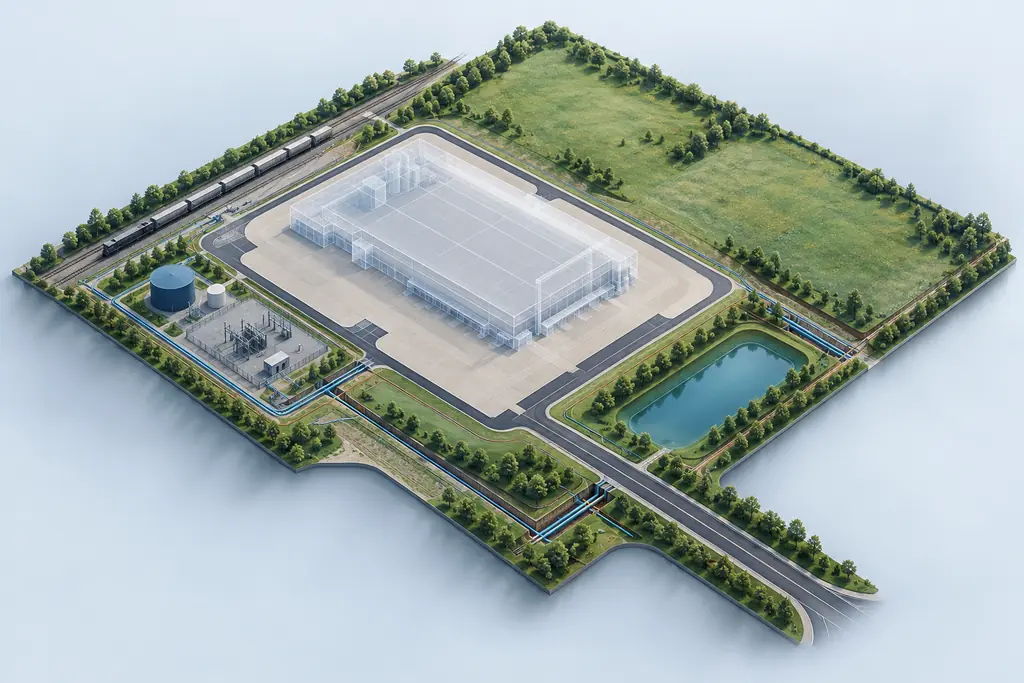
Concept illustration of manufacturing site readiness; not a client site or engineering plan.
The location decision shapes the path to production.
Manufacturing site selection affects time to market because the property determines which utility, approval, construction, equipment, workforce, and supply chain dependencies must be resolved before production can begin. Availability is one milestone in that longer delivery plan.
Property available
The team can pursue control of a parcel or building. Required due diligence, design, approvals, or infrastructure work may remain.
Ready to commission
The equipment, required services, technical team, and applicable prerequisites are ready for the planned tests.
Ready to supply
The operation meets the quality, output, staffing, and customer requirements defined for the launch.
Define which outcome the target date represents. A first trial run, first customer shipment, and stable production are different commitments. Bring that definition into site selection before comparing properties.
Work backward from the output you need.
Start with the required launch outcome, then identify what must be completed before it. This is a planning sequence; the detailed schedule should show which activities can overlap and which depend on earlier work.
04 · Deliver
Define the product, quality, volume, customer acceptance, and shipment conditions required at launch.
03 · Qualify
Identify commissioning, process validation, operator readiness, supplier qualification, and any customer approval milestones.
02 · Install & integrate
Confirm equipment access, foundations, building systems, services, specialist support, and the installation and testing plan.
01 · Enable the site
Resolve site control, due diligence, design, approvals, civil work, utility scope, and the building requirements that enable later activity.
Then build the delivery schedule forward with responsible owners and realistic durations. The manufacturing expansion timeline helps connect the location decision with development and startup.
Identify what controls the launch date.
The critical path is the controlling sequence of dependent activities in the schedule. A delay on that path can move completion; a delay elsewhere may first use up available schedule slack. The controlling path can change as the project develops.
| Arbeitsbereich | Dependency to verify | What may start earlier |
|---|---|---|
| Versorgungsunternehmen | Required service phase, delivery conditions, customer work, and readiness before the relevant tests. | Load definition and provider assessment during site evaluation. |
| Approvals & site work | Applicable design and approval steps before each construction activity. | Agency discussions and due diligence using a defined process brief. |
| Building & equipment | Physical and system prerequisites for delivery, installation, testing, and qualification. | Equipment specifications, procurement planning, and building-fit review. |
| Belegschaft | Experienced launch roles, training, and qualification before assigned tasks. | Recruiting, partner engagement, and suitable off-site training. |
| Materials & logistics | Qualified inputs, handling, inventory, and routes before the production runs that need them. | Supplier validation and logistics planning while the facility is developed. |
Concurrent activity helps only when prerequisites, resources, and responsibilities are understood. An aggressive date does not remove a physical or approval dependency. Record the logic behind the schedule rather than relying on a list of target dates.
Match utility delivery to commissioning—not just building completion.
Specify the service phase
Separate construction service, commissioning loads, and full production demand. Each can have a different scope and required date.
Verify the delivery basis
Document provider assessments, required work, delivery conditions, customer responsibilities, and the assumptions behind the proposed date.
Allow for startup work
Include the tests, inspections, qualification, and other preparation that follow a utility connection. Energization alone does not establish saleable output.
Some installation may proceed before full service is available, while particular tests cannot. Confirm that sequence with the technical team instead of treating all equipment activity as one milestone.
Use the utility readiness framework to check electricity, water, wastewater, gas, and connectivity against the actual process.
Existing buildings and greenfield sites have different paths.
Existing facility
Verify floor loading, equipment routes, clearances, docks, electrical distribution, HVAC, process utilities, and other required modifications. A vacant building may still need substantial work.
Greenfield development
Assess due diligence, geotechnical conditions, grading, drainage, access, utility extensions, approvals, and construction sequencing. Confirm what has been completed and what remains.
For either option, identify the relevant approval pathway with the responsible authorities and specialists. Record which requirements depend on final design or the proposed manufacturing process.
The site readiness assessment should describe readiness for your operation. A general development label cannot establish the date your equipment and process will be ready to run.
Build the opening team and material flow while the site develops.
Launch-critical people
Recruit leaders, maintenance, controls, engineering, and quality roles early enough to support the tasks assigned to them. Confirm when each must be on site.
Training with delivery dates
Verify instructor and equipment capacity, available seats, training sequence, and qualification. Include the time experienced staff need to support new employees.
Inputs ready for the first runs
Confirm qualified materials, inbound routes, receiving arrangements, storage, handling, and supplier support before the tests and production runs that require them.
Use workforce analysis to validate recruiting assumptions, and combine training pathways and recruiting according to the launch schedule.
The supply chain location guide helps connect the facility with suppliers, freight routes, and recovery options. Keep those workstreams on the same schedule as construction.
Make a delay’s downstream effects visible.
Imagine a required utility service phase arrives later than planned. The following is an illustrative dependency test, not a reported client project or a forecast of how long a delay will last.
Service date moves
Update the forecast using the provider’s current information and identify which tests require that service.
Testing is affected
Re-sequence work where feasible, then assess commissioning and qualification activities that cannot proceed.
Resources must adjust
Review specialist bookings, staff training, supplier deliveries, inventory, and temporary support.
Launch outcome is reassessed
Check the controlling path, remaining slack, and recovery options before revising customer or production commitments.
The effect on the final date depends on the schedule logic and available slack. Do not automatically add the same delay to every downstream task; recalculate the connected plan and identify what actually changes.
Compare sites on their credible path to output.
Consider two hypothetical options. Neither is a universal winner: the comparison shows which evidence a team needs before deciding whether a lower acquisition cost compensates for schedule exposure.
| Comparison | Site A · more work remains | Site B · more work verified |
|---|---|---|
| Property economics | Lower acquisition cost. | Higher acquisition cost. |
| Utility position | Upgrade scope and service timing remain unresolved. | A documented service plan exists, subject to stated conditions. |
| Building & development | Required modifications or site work still need validation. | More of the proposed operating requirements have been assessed. |
| Workforce & suppliers | Training and startup support need further confirmation. | More launch assumptions are supported by partner evidence. |
| Decision focus | Can the gaps be resolved in time, and at what cost? | Do the documented conditions remain valid for the final design? |
Apply the same output target, operating brief, and evidence standard to both. Verify the remaining conditions rather than treating the hypothetical descriptions as guarantees.
Use the manufacturing location scorecard to compare viable options. Keep a critical launch constraint visible as a decision gate instead of averaging it into a total.
Put schedule exposure into the economics.
A delay may change equipment storage, temporary facilities, contractor support, carrying costs, staffing, expedited freight, and customer delivery timing. The effect depends on the project and the actions taken to recover.
Model the exposure
Compare the credible cost of a later launch with the capital and recurring costs of each location. State the scenario and avoid treating uncertain revenue as guaranteed.
Model the response
Identify recovery actions, their cost, their prerequisites, and whether they can change the controlling path. Extra resources do not shorten every task.
Keep costs consistent across scenarios and avoid counting the same disruption twice. The manufacturing cost analysis should use the same ramp-up and service assumptions as the project schedule.
Set a contingency appropriate to the uncertainty and delivery evidence. Distinguish time reserved for uncertainty from an informal promise that the team will recover any delay.
Give every critical gap an owner and a decision date.
- Capture the dependency: what must happen, what it enables, and which production milestone it affects.
- Record the evidence: source, date, assumptions, confidence, and conditions that could change the forecast.
- Assign the response: accountable owner, next action, required resolution date, and contingency.
- Maintain the plan: update actual progress and forecasts, reassess the controlling path, and surface changes before commitments are made.
WorldPoint connects location strategy with utilities, infrastructure, workforce, logistics, and expansion planning. Project collaboration helps keep assumptions and responsibilities aligned across the organizations involved. Licensed brokerage activities are handled separately through CBREG True Team where appropriate.
The result should be a location recommendation with a documented path to launch and a clear view of the conditions still to be met.
Manufacturing time-to-market FAQs
How does manufacturing site selection affect time to market?
The site determines which utilities, approvals, building work, equipment prerequisites, workforce, and logistics tasks must be completed before launch. A faster property decision does not by itself establish an earlier production date.
What production date should a site selection team use?
Define the outcome explicitly: trial production, qualified output, first customer shipment, or stable volume. The prerequisites and timing can differ, so all candidate sites should be evaluated against the same milestone.
How long does manufacturing site selection take?
There is no universal duration. The operating requirements, location options, due diligence, provider assessments, approvals, and unresolved conditions determine the work needed. Build a project-specific schedule rather than relying on a generic time estimate.
Is an existing building always faster than a greenfield site?
No. An existing facility may need substantial modification, while a greenfield option may have completed useful preparation. Compare the actual development and startup requirements for the proposed process.
Can utility delays affect commissioning?
Yes, when the affected tests or production tasks require that service. Some installation or preparation may continue, so assess the actual dependencies and schedule slack before estimating the effect on the launch date.
When should workforce planning begin?
During site evaluation, early enough to validate the critical roles, recruiting conditions, training capacity, and qualification dates. Launch leaders and technical specialists may be needed before the broader production workforce.
Can project workstreams run in parallel?
Often some can, including recruiting, supplier planning, and parts of design or due diligence. Confirm prerequisites, resources, approval conditions, and responsibilities before assuming overlap will shorten the project.
How should manufacturers compare sites for launch speed?
Use a shared operating brief and launch milestone. Compare remaining work, dependency logic, delivery evidence, owners, conditions, contingency, and schedule-related cost rather than relying only on acquisition speed.
A documented schedule makes the comparison stronger.
The GAO Schedule Assessment Guide explains how an integrated schedule can test whether milestones are realistic and show the cost effects of schedule slippage. Those scheduling principles inform the dependency-based planning approach used here.
The roadmap, delay exercise, and site comparison above are WorldPoint planning guidance. They do not promise a particular project duration or outcome. Use the manufacturing expansion guide to connect the location review with the wider investment plan.
Choose a location with a clear path to launch.
Bring your target production outcome, process requirements, and expansion timeline. WorldPoint can help identify the location dependencies that need to be resolved first.