
DATA CENTER CAMPUS STRATEGY
Planning Data Center Sites for Future Campus Expansion
Choose a site that can support the campus you intend to build. Connect today’s data hall to the land, utilities, routes, and delivery decisions that later phases will need.
By Hunter Drinkall · Published September 9, 2026
Updated October 20, 2026
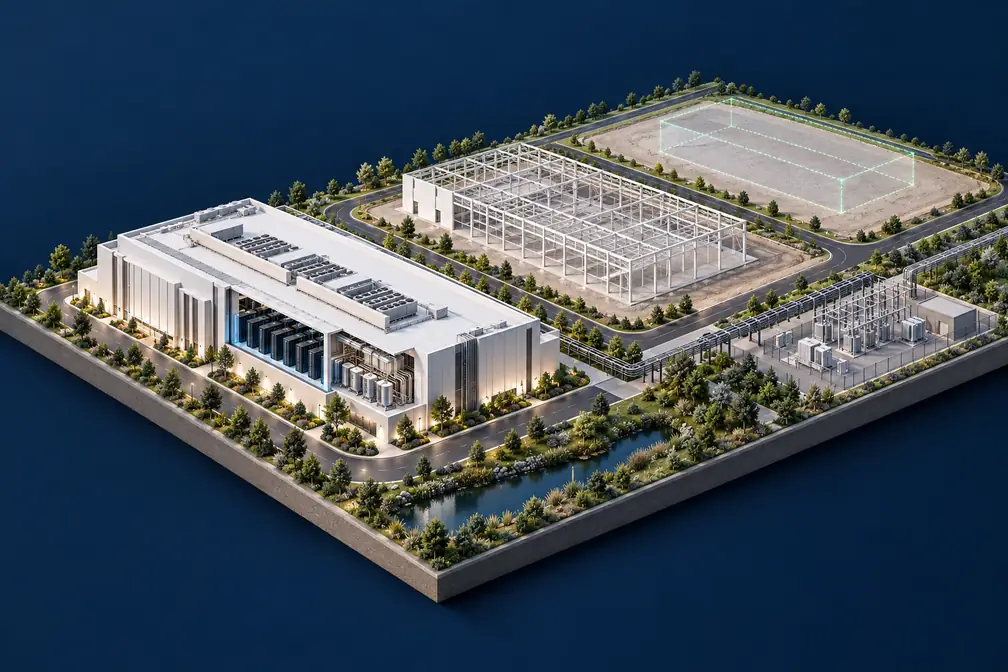
Conceptual illustration of an operating building, future construction, and reserved expansion land. Not an actual client project or an engineering design.
Make the first building support the wider campus
Data center campus expansion planning evaluates whether a location can support successive phases as demand, computing density, cooling needs, and delivery priorities change. The first building’s layout and infrastructure choices can shape the options available to every later phase.
Start with a campus concept before selecting land. Use it to test how each deployment will be supplied, built, commissioned, operated, and expanded. Keep demand forecasts and technical assumptions visible so the plan can evolve as the project develops.
Operate the initial phase
Establish the opening requirements and the infrastructure needed to support them. Identify the conditions the operating team will depend on.
Deliver the next phase
Show how future construction, equipment delivery, utility connections, and commissioning can proceed beside the operating facility.
Preserve later options
Protect the space, routes, rights, and infrastructure choices needed for longer-term growth. Record assumptions that remain conditional.
Translate the growth plan into a phase roadmap
Define the expected IT load, total facility demand, cooling concept, network needs, reliability objectives, and delivery priorities for each planned deployment. Separate the base case from alternative growth scenarios; an aspiration is not a confirmed infrastructure commitment.
Illustrative planning structure. The roadmap below shows how the questions change across a campus. It represents no actual site, capacity commitment, or promised delivery date.
| Campus stage | Planning objective | Evidence to develop | Options to preserve |
|---|---|---|---|
| Initial deployment | Commission and operate the first building. | Opening load, service conditions, layout, access, and commissioning prerequisites. | Future utility corridors, construction access, and expansion envelope. |
| Next deployment | Build and connect another phase. | Service path, required works, approvals, construction separation, and operating interfaces. | Practical tie-in locations and space for later infrastructure. |
| Later campus | Keep the intended growth path feasible. | Scenario-based capacity review, land arrangements, approval path, and delivery dependencies. | Usable land, route access, and alternatives if demand or technology changes. |
Assign a decision owner and a review date to each assumption. Update the roadmap when customer demand, equipment specifications, the campus layout, or external service conditions change.
Reserve usable space for buildings and infrastructure
Test the full concept layout against site investigations and applicable requirements. A generous parcel can still have a constrained development envelope once drainage, topography, easements, protected areas, setbacks, and access are considered.
Development envelope
Locate data halls, substations, cooling equipment, backup systems, parking, security, stormwater facilities, and support areas. Test each planned phase against the usable layout.
Infrastructure corridors
Show the routes needed for power, telecommunications, water, wastewater, and other relevant services. Check whether later works would cross operating systems or consume another phase’s footprint.
Access and land arrangements
Allow for heavy-equipment delivery, construction staging, emergency access, and future works. Review any adjoining land or third-party rights needed for the intended campus.
Use a site readiness assessment to connect the physical constraints with the development plan. Surrounding development also deserves review where it could affect access, utility routes, or future land arrangements.
Build a utility roadmap for every planned phase
Give the serving utility a phased facility load profile and explain the assumptions behind it. Request the applicable load-service process for the project, with the studies, works, agreements, and delivery conditions that each phase would require.
Capacity and timing
Compare initial demand, later demand, and credible alternatives for a faster ramp or higher density. Ask what can be served, when, and on what documented basis.
Works and responsibilities
Identify connection points, equipment, upgrades, route access, procurement, and approval dependencies. Record the parties responsible for funding and delivering each element.
Conditions and commitments
Distinguish preliminary discussions from completed studies or executed arrangements. Clarify what any capacity reservation covers, what remains conditional, and when assumptions need review.
Give later phases their own service test
Initial service does not establish the delivery path for future load. Keep later-phase capacity, required works, timing, and outstanding conditions visible in the same roadmap.
The data center power-capacity guide supports early utility discussions. Extend the roadmap to water, wastewater, stormwater, network service, and gas where the project requires them.
Let network resilience scale with the campus
Routes and physical diversity
Review provider capabilities, actual route information, building entrances, conduit capacity, and shared dependencies. Ask how each future building can receive the connectivity and resilience required by its operating brief.
Construction and activation
Identify last-mile works, rights, corridor access, delivery responsibilities, and activation prerequisites. Check how later installation or maintenance could interact with the live network and other campus infrastructure.
Keep the network plan coordinated with the civil and utility layouts. Multiple providers may still depend on common physical infrastructure, and a future building footprint may conflict with a route assumed during the first phase.
Plan cooling, water, and equipment space together
Later deployments may use different equipment densities or cooling approaches. Ask engineers to test the campus against credible technology scenarios, including the effects on electrical demand, water needs, mechanical space, and heat rejection.
Cooling flexibility
Review the selected design basis, climate assumptions, equipment space, maintenance access, and the interfaces needed for future systems. Identify decisions in the first phase that would make later adaptation difficult.
Wasser und Abwasser
Where the design requires them, review demand, quality, treatment, discharge, service conditions, restrictions, and resilience for each phase. Confirm the improvements and approvals needed to support later loads.
The U.S. Department of Energy’s data center design best practices guide covers IT, cooling, and electrical systems. It provides useful technical context for coordinating design assumptions; the campus requirements should come from the project’s engineering team.
Review approvals, people, and off-site works at campus scale
Approval coverage
Review the intended campus with the relevant authorities and advisers. Record which buildings, infrastructure, operating activities, and future changes are covered, conditional, or subject to further review.
Workforce and support
Assess construction trades, commissioning capability, facilities staff, security, network specialists, vendors, training, and relevant relocation needs. Consider competing demand when evaluating later delivery periods.
Off-site dependencies
Review equipment routes, road improvements, emergency access, utility extensions, and other external works. Bring third-party responsibilities and delivery prerequisites into the campus schedule.
Use project management and collaboration to keep these workstreams connected. An issue outside the parcel can still determine when the next building is ready.
Plan future construction around live operations
A campus plan should explain how the next phase will be delivered while existing facilities continue operating. Develop the interfaces with the design, construction, commissioning, security, and operations teams before works begin.
Separate the work areas
Define construction boundaries, delivery routes, contractor access, staging, emergency arrangements, and environmental controls appropriate to the works and operating site.
Sequence the connections
Identify tie-ins, isolation requirements, testing, and any work affecting live services. Document dependencies, proposed interruptions, and the operational procedures needed to manage the work.
Define the handover
Set responsibilities for acceptance, commissioning evidence, system documentation, operating preparation, and transition into service. Confirm how the new phase changes campus responsibilities.
For example, an electrical route through a future building footprint creates a different problem from a reserved perimeter corridor. Test those layout choices while alternatives remain practical.
Pressure-test the plan before the next commitment
Compare finalists against the same growth scenarios. Show what changes, the evidence needed, and the consequence for the campus. The examples below are planning prompts, not predictions or site-specific findings.
| Szenario | What to test | What leadership should see |
|---|---|---|
| Demand arrives earlier | Utility works, procurement, approvals, contractors, and commissioning sequence. | Whether delivery can accelerate and which conditions control the date. |
| Higher computing density | Facility power, cooling approach, equipment space, and network demand. | Which infrastructure or layout assumptions need revision. |
| A different cooling strategy | Water, wastewater, electrical demand, heat rejection, and mechanical interfaces. | The adaptation path and its implications for cost and delivery. |
| A utility upgrade moves later | Phase sequencing, deployment alternatives, and remaining service conditions. | Which phase is affected and what decision or mitigation is available. |
| Growth slows or changes shape | Shared infrastructure, land arrangements, and the order of future investments. | Commitments that remain useful and decisions that can be deferred. |
Include the economics of each scenario. The guide to data center site costs beyond land price explains why enabling works, operating assumptions, and timing belong in the same comparison.
Use an evidence checklist before committing to each phase
A practical phase review should explain whether the current plan remains feasible and what must be resolved before the next commitment. The checklist below is a planning aid, with ownership assigned to the relevant project teams.
| Review area | Evidence to bring forward | Suggested owner |
|---|---|---|
| Demand and design | Updated phase brief, load profile, density assumptions, cooling concept, and operating objectives. | Project sponsor and engineering team |
| Land and layout | Usable footprint, future routes, access, staging, and required land or third-party rights. | Design, property, and legal teams |
| Utilities and network | Provider responses, service path, works, responsibilities, dates, and outstanding conditions. | Utility and network leads |
| Approvals | Coverage, conditions, additional reviews, and dependencies for the proposed phase. | Planning and permitting lead |
| Construction and operations | Separation plan, connection sequence, commissioning, and operating interfaces. | Construction, commissioning, and operations leads |
| Economics and decision | Updated costs, funding assumptions, relevant incentive conditions, risks, and unresolved decisions. | Finance team and project sponsor |
Finish with a recommendation, an action register, and the conditions for proceeding. Expansion advisory support can help connect the location decision to the broader growth plan.
Data center campus expansion: FAQs
What is data center campus expansion planning?
It is the coordinated evaluation of how a location can support successive data center phases. It connects land, power, cooling, water, connectivity, approvals, construction, workforce, and operating requirements to the intended campus growth plan.
How much land should a data center campus reserve?
The answer depends on the full layout and operating brief. Evaluate usable space for data halls, electrical and cooling infrastructure, access, security, stormwater, staging, and future works after site constraints are considered. Gross acreage alone does not establish expansion capacity.
How should future power capacity be evaluated?
Give the serving utility a phased load profile with credible growth scenarios. Request the service path, studies, required upgrades, responsibilities, timing assumptions, and remaining conditions for each phase. Clarify what is preliminary, committed, or subject to further agreements.
Does first-phase utility service guarantee later capacity?
No. Later load may require additional studies, works, equipment, access, or agreements. Document the basis of any future-capacity assumption, including its conditions and limits, and refresh the utility review when demand or delivery plans change.
Why should cooling, water, and fiber be planned together?
Each system needs space, routes, service capacity, and a delivery sequence. Later cooling choices may change power or water requirements, while fiber construction may depend on shared corridors. Coordinating them early helps expose conflicts in the campus layout.
Can a new phase be built beside an operating data center?
The feasibility depends on the design and execution plan. Review construction separation, access, emergency routes, utility connections, testing, security, and operating procedures with the relevant teams. Identify any planned service interruption or work affecting live infrastructure before proceeding.
Do campus approvals automatically cover future buildings?
Coverage depends on the approvals, jurisdiction, project scope, and conditions. Review the intended campus with the relevant authorities and advisers, then record what is covered, conditional, or still requires review as future phases develop.
What should leadership review before committing to another phase?
Review the updated demand brief, layout, utility and network evidence, cooling and water plan, approval path, construction sequence, cost assumptions, and operating impacts. List unresolved conditions with owners and deadlines, and identify which ones could change the decision.
Turn the campus plan into a clear site decision
WorldPoint Site Selection helps industrial and digital-infrastructure leaders evaluate locations with infrastructure, workforce, incentives, economic development coordination, relocation needs, vendor introductions, and operational considerations in view.
Explore our site selection services or discuss whether a prospective U.S. site can support the phases you intend to deliver.
WorldPoint provides advisory support. Brokerage activities are handled separately through CBREG True Team.