
MANUFACTURING SITE READINESS
Shovel‑Ready vs. Site‑Ready: What Manufacturers Need to Know
Connect site preparation to the operation you need to run.
A prepared parcel can shorten early development work. A manufacturing site readiness assessment tests the utilities, people, approvals, access, and delivery dates behind the production plan.
By Hunter Drinkall · Published September 9, 2026 · Updated October 19, 2026
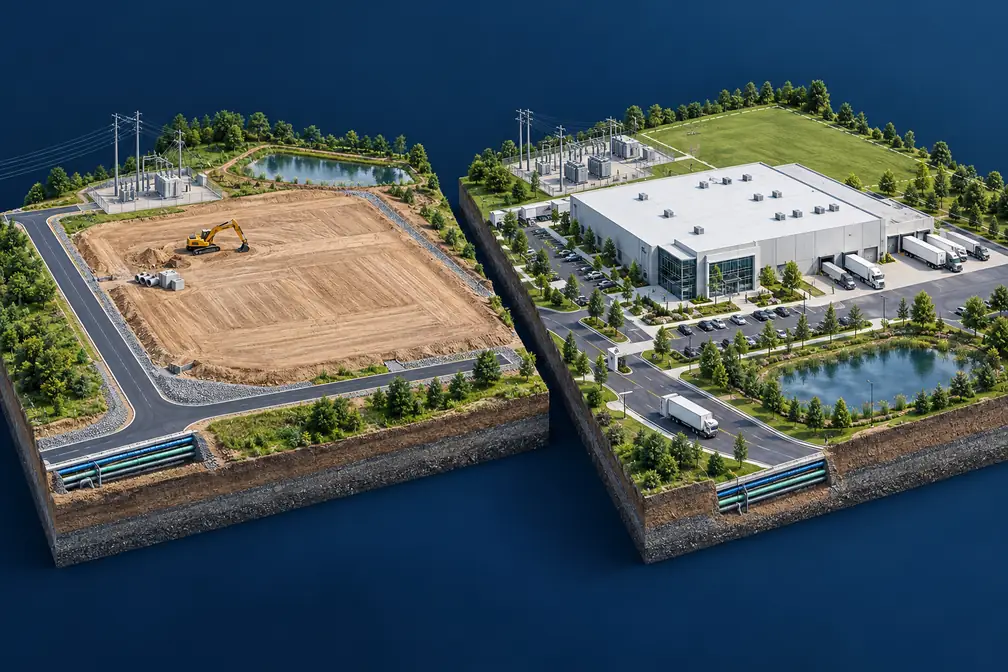
Conceptual illustration of site preparation and an operating campus; not an actual WorldPoint project.
THE PRACTICAL DIFFERENCE
Ask what is ready, for which operation, and by what date.
Shovel-ready status can signal useful progress on a property. The next question is whether the location can support your manufacturing process, hiring plan, utility demand, freight activity, and future growth on the required schedule.
Construction preparation
Review site control, zoning, due diligence, physical conditions, and the work completed to support development.
Operational fit
Test the location against the facility’s actual process, workforce, infrastructure, and logistics requirements.
Delivery certainty
Confirm remaining work, responsible parties, funding assumptions, dependencies, and credible completion dates.
COMPARE THE TWO QUESTIONS
Shovel-ready vs. site-ready: a practical manufacturing comparison.
Terminology matters: neither phrase should be read as a universal guarantee. In this guide, “site-ready” describes readiness for the proposed operation. A formal program may use the same term with its own defined criteria and levels.
| Review area | Construction preparation | Project-specific operational readiness |
|---|---|---|
| Core question | What work has been completed to help development begin? | Can this location support the planned operation and its schedule? |
| Land and approvals | Site control, zoning, reports, and entitlement progress. | Compatibility with the actual process, building, approvals, and development scope. |
| Utilities | Location of services and documented infrastructure preparation. | Required capacity, service quality, connection work, upgrade responsibilities, and delivery dates. |
| Workforce | Regional context or workforce information may be included. | Role-specific availability, hiring competition, wages, training, commuting patterns, and ramp-up needs. |
| Logistics | Road or other transport access may be documented. | Inbound and outbound routes, throughput, service constraints, and supplier or customer requirements. |
| Schedule | Readiness to advance defined development steps. | Coordination of construction, utilities, hiring, commissioning, and first production. |
| Expansion | Available acreage or conceptual development potential. | Future building area, process capacity, utilities, access, and any conditions on later phases. |
Read both columns as review questions, not a fixed certification checklist. Some site programs already address several operational factors; their scope still needs to be matched to your project.
UNDERSTAND THE STARTING POINT
What does shovel-ready mean for an industrial site?
In practical use, the label usually indicates that some early development work has been completed or documented. The exact scope depends on the community, developer, economic development organization, or certification program making the claim.
Preparation worth reviewing
Property: boundaries, ownership, site control, surveys, and pricing assumptions.
Development path: zoning, entitlements, environmental review, geotechnical information, and permitting progress.
Physical work: grading, access roads, drainage, and utility extensions—where included in the stated scope.
Questions behind the label
Who issued the designation, and which criteria or tier does it satisfy? What dates and site boundaries do the documents cover?
Which items are complete, which are conceptual, and which depend on the eventual user? What work must be repeated, updated, or expanded for your facility?
A documented starting point can reduce uncertainty. It still needs to be translated into the manufacturer’s development scope.
For the wider distinction between certification and project fit, see certified manufacturing sites vs. site readiness.
TEST THE OPERATING REQUIREMENTS
A site must fit the manufacturing operation it will support.
A distribution building, an automated production facility, and an energy-intensive plant can place very different demands on the same location. Start with a defined operating brief so the readiness review tests the right requirements.
Power & process utilities
Define electrical demand and quality, water, wastewater, gas, connectivity, redundancy where needed, and capacity for later phases.
People & support
Evaluate technical skills, operators, leadership, hiring competition, training partners, housing, commuting patterns, and specialist vendors.
Materials & movement
Review truck routes, rail or port requirements where relevant, suppliers, storage, customer access, and site circulation.
Use a project-specific readiness brief.
Connect the building, process, staffing, utility loads, freight activity, launch date, and future phases. Give each requirement an evidence source and a decision owner before comparing sites.
TURN CLAIMS INTO EVIDENCE
Manufacturing site readiness assessment checklist
Ask for documents and responsible-party confirmation that address your proposed operation. Where information is incomplete, record the gap and its effect on cost, timing, or feasibility.
| Workstream | Evidence or confirmation to request | Question to close |
|---|---|---|
| Property and physical conditions | Current surveys, site control, relevant environmental and geotechnical findings, grading and drainage assumptions. | Can the facility be developed within the understood scope and budget? |
| Electricity and other utilities | Provider input on project loads, capacity, connections, studies, upgrades, service quality, responsibilities, and schedule. | Can the required service be delivered when construction and commissioning need it? |
| Approvals and permitting | A project-specific approvals path, required studies, review steps, responsible parties, and schedule dependencies. | What approvals remain, and what could delay the critical path? |
| Workforce and training | Role-specific labor analysis, wage conditions, competition, recruitment plan, and training-partner discussions. | Can the needed team be hired and prepared for ramp-up? |
| Logistics and access | Route reviews, transport requirements, supplier/customer lanes, site access, and circulation needs. | Can materials and finished goods move at the planned volume and service level? |
| Cost and incentives | Comparable development and operating costs, upgrade assumptions, incentive terms, obligations, and payment timing. | Are the costs and achievable benefits aligned with the operating plan? |
| Expansion and resilience | Future-phase layouts, land control, utility headroom, access, relevant hazards, and operating contingencies. | Can the site support growth and manage the disruptions that matter to this operation? |
WorldPoint’s manufacturing site readiness assessment connects these workstreams with the project brief and delivery schedule.
MATCH READINESS TO THE CRITICAL PATH
Available now and available when needed are different questions.
Work back from the required production date. Equipment installation, commissioning, utility energization, hiring, and training may have different lead times. Put their dependencies on one integrated schedule before treating a site as ready.
01 / Define
Set the production date, process requirements, utility loads, staffing plan, and later phases.
02 / Verify
Obtain supporting documents and provider or stakeholder input. Separate confirmed facts from estimates.
03 / Close gaps
Assign each remaining study, approval, infrastructure item, or hiring action an owner and a required date.
04 / Refresh
Update the readiness review when loads, building scope, production demand, or delivery commitments change.
Use manufacturing infrastructure planning to connect utility work and facility development with commissioning needs.
A HYPOTHETICAL READINESS GAP
A prepared site can still have an unresolved production dependency.
Imagine a parcel with site control, suitable zoning, a completed access road, and useful due diligence. The planned production process requires an electrical upgrade whose delivery schedule has not yet been confirmed.
What is established
The completed property and development work provides a useful starting point.
What remains open
Required electrical service, any studies and upgrades, responsibilities, and energization timing.
The decision action
Obtain provider confirmation, map the dependency to commissioning, and test the effect of a delay.
This is a conceptual example, not an actual WorldPoint project. It does not mean every shovel-ready site needs utility upgrades; it shows why the project’s requirements and evidence must drive the assessment.
KEEP UNCERTAINTY VISIBLE
Three readiness assumptions to challenge early
“Utilities are nearby.”
Proximity is useful context. Confirm capacity, service quality, connection requirements, delivery timing, and the party responsible for each remaining item.
“The region has manufacturing labor.”
Test the specific skills, shift patterns, hiring competition, wages, training capacity, and realistic recruiting area your facility will need.
“Incentives make the gap manageable.”
Keep the infrastructure or workforce gap visible. Review the terms, eligible costs, timing, and obligations alongside the remaining delivery risk.
Connect the findings to facility location risk analysis and incentives advisory so the financial case and readiness plan use consistent assumptions.
MAKE THE NEXT DECISION CLEAR
Record the evidence, gaps, owners, and decision conditions.
A useful readiness report explains what the site can support, which requirements remain open, what it will take to close them, and when the team needs an answer. Avoid a single ready/not-ready label that hides material uncertainty.
Confirmed
Evidence supports the stated requirement within the assumptions and dates reviewed.
Open
A named party must verify a requirement or complete an action before the next commitment.
Does not meet
A critical requirement cannot currently be met. Reconsider the site or formally resolve the constraint.
A fast-start project may prioritize existing capacity and predictable approvals. A phased campus may accept more development work in exchange for expansion potential. In both cases, make the tradeoff explicit and show the impact on first production and long-term operations.
Our site selection services combine workforce, infrastructure, logistics, costs, incentives, and local coordination. When brokerage activity is needed, it is handled separately through CBREG True Team.
COMMON QUESTIONS
Shovel-ready vs. site-ready FAQs
What is the difference between shovel-ready and site-ready?
Shovel-ready usually describes preparation that can help a site move toward construction. In this guide, site-ready means the location has also been evaluated against the manufacturer’s specific operating requirements and schedule. Program definitions vary, so verify the designation and supporting documents rather than assuming either label guarantees readiness.
Does shovel-ready mean all utilities are available?
It does not establish that by itself. Ask which services are installed, where the connection points are, what capacity is available, what studies or upgrades are needed, who pays, and when the required service can be delivered. Confirm the answers with the relevant provider.
Is site-ready a formal certification?
The term can be used generally or within a formal program, such as SiteReady Iowa. Requirements depend on the issuing organization and designation level. WorldPoint uses project-specific readiness to describe the additional review of whether the location can support your operation; that review is not a government certification.
Can a certified site still require additional due diligence?
Yes. Certification can provide useful documented work, but the studies, assumptions, validity periods, and site boundaries still need to be checked against the proposed facility. Process-specific utilities, workforce, approvals, access, construction needs, and future phases may require further evaluation.
What should a manufacturing site readiness assessment cover?
It should connect property and building requirements with utilities, environmental and geotechnical conditions, permitting, workforce, logistics, cost, and expansion needs. Each workstream should identify the evidence, remaining gaps, delivery responsibilities, and dates needed to support the project schedule.
How should manufacturers confirm electrical readiness?
Start with the facility’s expected demand, load profile, power quality needs, and phased growth. Obtain provider input on capacity, connection requirements, studies, upgrades, equipment lead times, responsibilities, and delivery timing. A nearby line or substation alone does not answer those project-specific questions.
Can incentives offset a site readiness gap?
Incentives may help fund an eligible cost or improve the financial case, but their value depends on the terms and whether the project can meet them. Model the timing, obligations, and remaining gap separately. Funding does not by itself confirm that infrastructure or workforce will be available when needed.
When should a company evaluate site readiness?
Begin when defining the operating brief and screening locations, then deepen the review as finalists emerge. Resolve critical gaps before major commitments. Refresh assumptions when production demand, process requirements, utility schedules, construction scope, or expansion plans change.
Evaluate readiness before it becomes a production risk.
WorldPoint Site Selection helps manufacturers connect site conditions with operating requirements, utility timing, workforce needs, logistics, and growth plans. Build a clearer picture of the work remaining before major commitments.
CONTINUE YOUR REVIEW
Resources for your next site decision
Certification and readiness
Understand how a site designation fits within a broader manufacturing evaluation.
Manufacturing infrastructure
Connect utility and infrastructure needs with facility scope and launch timing.
A consistent comparison
Use shared criteria and evidence to compare the location options that remain viable.
Program definitions: formal readiness designations have their own scope and levels. For examples, review Indiana Site Certified and SiteReady Iowa. Request current criteria and supporting documents from the organization responsible for a site’s designation.