
Our Process
Certified Manufacturing Sites vs. Site Readiness
Certified Manufacturing Sites vs. Site Readiness
What Manufacturers Need to Know Before Choosing a Location
Manufacturing site selection is one of the most consequential long-term decisions an executive team will make. The location you choose shapes your cost structure, production reliability, workforce strategy, and ability to expand for decades.
Certification helps. It confirms that a defined level of due diligence has been completed. What it cannot tell you is whether a site can support your operation, at your scale, on your schedule. That question is what site readiness answers, and the gap between the two is where projects lose time and money.
Executive Summary
A certified manufacturing site:
Meets a defined certification standard
Reduces some early-stage due diligence
Provides a baseline documentation package
Signals community preparedness and commitment
A site-ready manufacturing location:
Has verified utility capacity for your specific load
Supports your workforce requirements within a realistic commuting shed
Fits your production process, not industrial use in general
Can scale with you over multiple phases
Aligns with your business strategy and target in-service date
The distinction in one line: certification is a property-level credential. Readiness is a project-specific determination.
Certified Site vs. Site Ready Site
| Certified Manufacturing Site | Site Ready Manufacturing Location |
|---|---|
| Meets a defined certification checklist | Meets your specific manufacturing requirements |
| Confirms documentation and basic feasibility | Confirms capacity, timelines, and operating performance |
| Addresses general industrial suitability | Addresses process loads, workforce needs, and future growth |
| Reduces early-stage uncertainty | Reduces construction, commissioning, and long-term operating risk |
| Answers "has this site been vetted?" | Answers "can this site run our operation for twenty years?" |
Readiness Is Not a Property. It Is a Relationship.
This is the single most important idea on this page, and it is the one most often lost in site marketing.
A site is never simply "ready." It is ready for a particular manufacturer, running a particular process, at a particular scale. Change the manufacturer and the same parcel produces a different answer.
A location that is ideal for a food processor may be entirely unsuitable for a semiconductor facility. The food processor needs substantial water supply and, critically, wastewater treatment headroom for high-strength effluent. The semiconductor facility needs ultrapure water, extraordinary power quality and redundancy, and vibration isolation the food processor would never think to ask about. Both facilities might look at the same certified 200-acre parcel. One of them has found a home. The other has found a problem it will not discover for eighteen months.
This is why certification, which is necessarily generic, cannot substitute for readiness, which is necessarily specific. A certificate describes the site. A readiness evaluation describes the fit between the site and your project.
What Is a Certified Manufacturing Site?
A certified manufacturing site (or certified industrial site) is a property that has completed a formal review through a state-run program or an independent third-party certification provider. The purpose is to give manufacturers confidence that foundational due diligence has been performed.
State-Certified Industrial Site Programs
Many U.S. states operate their own certified industrial site programs, establishing criteria for industrial suitability and requiring documentation before a site can be promoted as certified. Requirements may include land control, zoning, environmental assessments, and preliminary engineering.
Third-Party Certifications
Some communities and landowners pursue certification through engineering firms or consultants operating branded programs. These often mirror state programs but may apply different thresholds or categories.
What Certification Programs Typically Cover
Environmental due diligence. Phase I Environmental Site Assessments, wetlands screening, and preliminary analysis of constraints such as endangered species, cultural resources, and floodplains. Depth varies significantly by program.
Geotechnical investigations. Subsurface conditions, bearing capacity, and risks such as expansive soils, rock, or groundwater. These inform foundation design and construction cost assumptions.
Preliminary engineering. Conceptual grading plans, preliminary utility layouts, and basic access concepts. Supports feasibility analysis, rarely replaces project-specific engineering.
Ownership verification. Title review and identification of easements or encumbrances. Clear ownership prevents delays during land acquisition.
Utility identification. Documentation of which utilities are available in proximity to the site and at what voltage or line size. Documenting availability is not the same as confirming capacity for your project.
Zoning review. Confirmation that industrial uses are permitted and that no major land use conflicts exist.
The Objectives of Certification
Across programs, industrial site certification aims to:
Reduce initial due diligence time for manufacturers
Demonstrate basic industrial suitability
Increase marketing competitiveness for communities
Provide a standardized documentation package
Every one of those is genuinely useful. None of them is project-specific.
What Does Site Readiness Actually Mean?
Site readiness asks a different question than certification: can this site reliably support our specific manufacturing operation, at the required scale, on the required schedule, over the required lifespan?
At WorldPoint, we treat site readiness as a structured evaluation rather than a descriptive label. Nine dimensions, applied consistently to certified and non-certified sites alike, produce a comparable answer across candidate locations. That structure is the WorldPoint Site Readiness Framework, set out in full further down this page.
The operational substance behind those dimensions includes:
Electric power capacity — available load (MVA/MW), redundancy, reliability, and utility upgrade timelines
Water — source capacity, line sizes, pressure, and ability to support both process and domestic demand
Wastewater — collection system capacity, treatment plant headroom, industrial pretreatment requirements, and discharge limits
Natural gas — line size, pressure, firm capacity, and reliability for process heat or backup power
Broadband — redundant fiber routes, bandwidth, and service level agreements supporting connected operations
Transportation — interstate access, heavy haul routes, rail service, proximity to ports and airports, supplier and customer access
Workforce — availability, skills, wage competition, training partners, and long-term pipeline stability
Permitting — approvals required at local, state, and federal level, realistic timelines, and schedule risk
Environmental conditions — wetlands, floodplains, air quality attainment status, cultural resources, endangered species
Expansion capability — room to add buildings, equipment, and utilities, and whether the grid, water system, and labor market can grow with you
Three Ways Certified Sites Go Wrong
These patterns recur. None of them reflects a failure of certification. Each reflects the gap between a generic credential and a specific project.
The battery manufacturer and the transmission line
A battery manufacturer selects a certified site in part because a 230-kV transmission line runs nearby. The certification package documents it accurately.
What emerges later: the utility cannot deliver the required load for thirty months. A new substation is needed. Cost responsibility for the upgrade is unresolved. Construction proceeds, then waits.
The site was certified. It was not ready for that project.
The food processor and the wastewater plant
A food processing operation confirms an adequate water line during evaluation. Supply is not the constraint.
Discharge is. The municipal wastewater treatment plant lacks the headroom for the facility's volume and effluent strength, and expanding it is a multi-year capital project on the municipality's timeline, not the manufacturer's.
Certification passed. Production was delayed.
The automotive supplier and the labor shed
An automotive supplier finds a certified site with genuinely strong utilities. Power, gas, water, and wastewater all check out.
The labor shed does not. Skilled workers within a realistic commuting distance are already spoken for by two existing plants, and wage competition is escalating. Reaching full staffing takes eighteen months, and the ramp curve is nothing like the model.
Everything the certification covered was accurate. Nothing the certification covered was the problem.
Certified Does Not Always Mean Ready
Certification is valuable. It shortens due diligence, signals community commitment, and establishes a baseline. It does not confirm readiness for your specific manufacturing process.
| Certified Manufacturing Site | Site Ready Manufacturing Location |
|---|---|
| Due diligence completed | Infrastructure supports operations |
| Environmental studies performed |
Utility capacity confirmed available |
| Ownership verified | Workforce available at required scale |
| Zoning reviewed | Transportation network validated |
| Certification requirements met | Manufacturing requirements validated |
| Initial engineering complete | Long-term expansion supported |
What Certification Answers vs. What You Still Need to Know
| Certification May Confirm | You Still Need to Evaluate |
|---|---|
| Environmental review | Electrical capacity for your load |
| Ownership and control | Labor availability for your skill mix |
| Zoning | Utility delivery timelines |
| Preliminary engineering | Total operating costs |
| Site boundaries | Supply chain impacts |
| Existing infrastructure | Future scalability |
From Certification to Decision
The relationship between the two is sequential rather than competitive. Certification is a useful input. Readiness evaluation is what converts it into a decision.
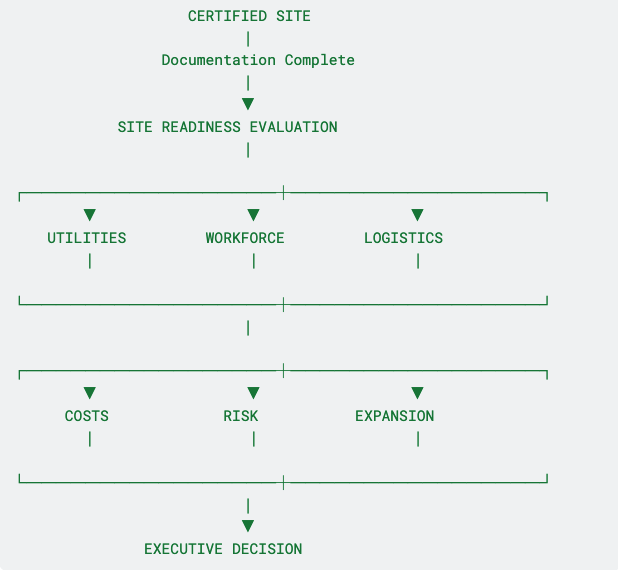
Certification gets you to the second box. Everything below it is project-specific, and everything below it is where schedule and cost are actually determined.
Questions Every Manufacturer Should Ask About a Certified Site
Probe beyond the certificate:
Is there enough electrical capacity for our current and future load?
Will utilities require upgrades (substations, lines, mains) to serve our facility, and who pays for them?
Can the wastewater system support our production volumes and discharge characteristics?
Is natural gas capacity and pressure adequate for our process requirements?
Is broadband both robust and redundant, with diverse fiber routes?
Can rail be added or expanded if our logistics strategy changes?
Is future expansion physically possible on-site, and can utilities and workforce scale with us?
What infrastructure costs remain for us to fund before construction can begin?
Which permits remain outstanding, and what are the realistic timelines?
How long before production can begin, accounting for utilities, permitting, and construction?
Utility Capacity Is Often the Largest Unknown
Across the U.S., utility capacity has become one of the most critical constraints in manufacturing site selection. Demand growth from EV manufacturing and battery facilities, data centers and AI infrastructure, and semiconductor and advanced materials plants is straining grid resources across many regions.
A certified site may accurately document utility access, such as an existing 115 kV line or a nearby water main. That documents proximity. It does not guarantee capacity for your project, nor establish how long new infrastructure will take to build.
Manufacturers need to understand:
Available electrical load and system redundancy
Substation and transmission upgrades required, and cost allocation
Water and wastewater plant headroom and committed investment plans
Natural gas system constraints and competing loads
Note again how project-specific this is. The same substation that constrains a 60 MW facility is entirely adequate for a 6 MW one.
Workforce Readiness Matters Too
Certification often stops short here. A site can be certified as industrially suitable while sitting in a market with limited labor availability or intense wage competition.
Workforce readiness includes:
Labor availability — how many workers with relevant skills sit within a realistic commuting shed
Labor quality — experience with comparable manufacturing processes and technologies
Wage competition — existing manufacturers, announced projects, and sector wage dynamics
Existing manufacturers — potential partners, suppliers, and competitors for the same talent
Commuting patterns — how workers move across the region and which locations attract them
Technical colleges — programs aligned to your skill needs, and their throughput capacity
Workforce development — state and regional training programs, apprenticeships, and incentives
Future hiring — demographic trends and pipeline strength five to ten years out
Unemployment rates alone reveal almost nothing about whether a region can sustain your workforce needs. The relevant question is not how many people are available, but how many people with your required skills are available and not already committed.
Infrastructure Beyond Utilities
Transportation affects both day-one operations and long-term cost competitiveness:
Interstate access — distance, congestion, and reliability of highway connections
Rail — on-site or near-site service, short line versus Class I carriers, and service quality
Ports — proximity and capacity for import and export operations
Airports — access for executives, customers, and time-sensitive shipments
Heavy haul routes — ability to move oversize equipment and finished product
Bridge weight restrictions — constraints that could limit routing options
Supplier access — travel times and logistics costs for key inputs
Future transportation improvements — planned projects that could enhance or disrupt access
Operating Performance Is Where Projects Are Actually Won
Manufacturing is not won during construction. It is won across twenty years of operation.
Site selection conversations gravitate toward capital cost and schedule because both are visible, quantifiable, and immediate. They are also a small fraction of what the location will ultimately determine. A site that saves three million dollars at construction and costs two million a year in freight inefficiency has been expensive since the day it opened.
Operating performance is what a location delivers once the ribbon is cut:
Uptime — production hours lost to utility interruption, voltage sag, or supply failure
Utility reliability — grid stability, water pressure consistency, gas supply firmness under peak regional demand
Labor retention — turnover rates, cost of continual rehiring and retraining, institutional knowledge lost
Freight efficiency — cost per unit shipped, carrier availability, transit time reliability to key customers
Maintenance — access to skilled trades, equipment vendors, and parts supply
Expansion — whether phase two happens on this site or requires a second location and a duplicated overhead structure
None of these appears on a certification checklist, and none of them can be evaluated generically. Each depends entirely on what you are making, how you are making it, and where it needs to go.
How Site Readiness Affects Total Project Cost
Two sites can carry similar land prices and identical certification labels while producing dramatically different total project and operating costs.
Cost drivers linked to readiness include:
Utility upgrades — substations, lines, mains, and on-site infrastructure
Schedule delays — time to secure approvals, complete design, and build critical infrastructure
Carrying costs — capital tied up while a project waits on utilities or permits
Construction delays — impacts from site conditions, weather, or permitting gaps
Lost production — revenue and market share consequences of delayed ramp-up
Financing costs — interest and structures affected by schedule risk
Expansion limitations — higher costs later when growth requires relocation or major upgrades
Permitting and Development Risk
Even at certified sites, permitting can materially affect timeline and cost:
Wetlands — presence, delineation status, and mitigation requirements
Floodplains — flood zones, base flood elevations, and design implications
Stormwater — detention, treatment, and downstream impact requirements
Air permits — attainment status, emissions limits, and permitting complexity
Environmental approvals — state and federal reviews that extend schedules
Local approvals — zoning, variances, design review, and building permits
Community concerns — potential opposition, public meetings, and political risk
Cultural resources — archaeological or historical resources requiring mitigation
Endangered species — habitat considerations and required studies
Timeline impacts — how each of the above bears on your target in-service date
The WorldPoint Site Readiness Framework
Site readiness becomes actionable when it is structured. We evaluate every candidate location, certified or not, across nine dimensions. Applied consistently, they make otherwise incomparable locations directly comparable.
| # | Dimension | The question it answers |
|---|---|---|
| 1 | Infrastructure | Does the physical site support the facility, given layout, topography, geotechnical conditions, and buildable area? |
| 2 | Utilities | Can electric, water, wastewater, gas, and broadband deliver required capacity on the required schedule? |
| 3 | Workforce | Can this labor market staff the operation at launch and sustain it through growth? |
| 4 | Logistics & Supply Chain | Do road, rail, port, and air connectivity support inbound supply and outbound distribution at competitive cost and reliability? |
| 5 | Operating Costs | What will it cost to run here annually across labor, utilities, taxes, insurance, and freight? |
| 6 | Incentives | What is genuinely available, what are the clawback conditions, and what is the real impact on total cost? |
| 7 | Risk | What environmental, regulatory, permitting, political, and climate exposures apply, now and prospectively? |
| 8 | Expansion Potential | Can land, utilities, and workforce support phase two and phase three without relocation? |
| 9 | Implementation Timeline | Working backward from the target in-service date, does this location make the schedule? |
Two features make the framework useful in an executive setting It is applied identically to certified and non-certified sites. Certification changes how much information is already assembled. It does not change which questions need answering. A non-certified site evaluated across all nine dimensions is better understood than a certified site accepted on its documentation.
It is calibrated to your project, not to a generic standard. The same nine dimensions produce different conclusions for a food processor and a semiconductor fab, because the thresholds within each dimension come from your process requirements. That is the difference between an evaluation and a checklist.
We deliver the output as scorecards and comparative rankings, so executive teams can see tradeoffs across locations at a glance and connect the site decision to broader business strategy.
When a Non-Certified Site May Be the Better Choice
Certified sites can be attractive. Many cases still favor a non-certified location, which may offer:
Better workforce access and deeper talent pools
Stronger logistics and supply chain connectivity
More favorable utility capacity and long-term headroom
Lower operating costs for power, labor, and taxes
Closer supplier networks and ecosystem advantages
Greater expansion potential across future phases
Certification is one evaluation factor. The best manufacturing location is the one that aligns most closely with your operational requirements and business objectives, whatever label it carries.
Common Misconceptions About Certified Manufacturing Sites
"A certified site is shovel-ready." Certification streamlines early due diligence. It does not mean all permits are in hand, all infrastructure is built, or construction can begin immediately. Additional design, permitting, and utility work is frequently required.
"Certification guarantees utility capacity." Certification documents that utilities are present or planned, not that they can immediately and fully serve your specific load. Grid constraints and competing projects still limit availability and extend timelines.
"Certified sites eliminate project risk."Certified sites reduce some risks, particularly around ownership and environmental history. They do not eliminate permitting, utility, workforce, or construction risk.
"Every certification program uses the same standards." Standards vary substantially by state and by third-party provider. Some emphasize documentation, others infrastructure. Understanding the differences is essential when comparing sites across multiple states.
"Certified sites are always the fastest option." A non-certified site with strong existing utilities and straightforward permitting frequently reaches production faster than a certified site requiring major upgrades or complex approvals.
Manufacturing Site Readiness Checklist
✓ Verify utility capacity (electric, water, wastewater, natural gas, broadband) against your specific loads
✓ Confirm water and wastewater availability for current and future volumes
✓ Review transportation infrastructure (road, rail, port, air, heavy haul)
✓ Complete workforce analysis that goes beyond unemployment rates
✓ Understand permitting requirements and realistic timelines
✓ Evaluate environmental conditions and potential constraints
✓ Compare total operating costs across candidate locations
✓ Analyze incentives in the context of total cost, including clawback terms
✓ Assess expansion opportunities and utility scalability
✓ Evaluate supplier proximity and supply chain resilience
✓ Review construction timeline risks and contingencies
✓ Conduct independent due diligence rather than relying on certification materials alone
Frequently Asked Questions
What is a certified manufacturing site?
An industrial property that has completed a formal certification process, typically through a state program or third-party provider, confirming elements such as ownership, zoning, environmental review, and basic infrastructure.
What is site readiness?
The degree to which a location's utilities, infrastructure, workforce, permitting, and expansion capacity can support a specific manufacturing operation's requirements, timelines, and growth plans. Readiness is always relative to a project.
What is the difference between a certified site and a shovel-ready site?
"Certified" refers to completion of a defined due diligence checklist. "Shovel-ready" implies most permits and infrastructure are in place so construction can begin quickly. Definitions vary, and neither term guarantees utility capacity or schedule certainty without additional analysis.
Does certification guarantee utility capacity?
No. Certification confirms utility access and basic planning, not that the system can deliver your required capacity or that upgrades will meet your schedule.
Can a site be ready for one manufacturer and not another?
Yes, and this is the central point. A site with abundant water but constrained wastewater treatment may suit a light assembly operation and fail a food processor entirely. Readiness is determined by the fit between site capacity and process requirements.
Are certified manufacturing sites always the best option?
Not necessarily. Non-certified sites may offer better workforce, logistics, utilities, operating costs, or expansion potential.
How do manufacturers evaluate site readiness?
Through detailed due diligence across utilities, workforce, logistics, permitting, environmental risk, total cost, and scalability. The WorldPoint Site Readiness Framework organizes this into nine dimensions applied consistently across candidate locations.
Why is workforce important during site selection?
Workforce determines your ability to staff and grow operations, maintain quality, and control labor costs. A sustainable talent pipeline is essential to long-term performance.
How long does manufacturing site due diligence take?
Timelines vary by project scale and market conditions. Even with certified sites, comprehensive due diligence often takes several months, particularly around utilities, permitting, and environmental factors.
What infrastructure should manufacturers evaluate?
Electric power, water, wastewater, natural gas, broadband, roads, rail, ports, airports, and heavy haul routes, together with planned future improvements.
Do all states certify industrial sites the same way?
No. Criteria, depth of review, and terminology vary widely. Understanding each program's standards is critical when comparing certified sites across states.
How does WorldPoint evaluate manufacturing sites?
Through the WorldPoint Site Readiness Framework: infrastructure, utilities, workforce, logistics and supply chain, operating costs, incentives, risk, expansion potential, and implementation timeline. Our guidance is independent and calibrated to your specific manufacturing requirements.
Why Manufacturers Work With WorldPoint
WorldPoint Site Selection evaluates far more than certification status. Our independent team assesses manufacturing infrastructure and utility capacity rather than access alone, workforce availability and development pipelines, transportation and logistics performance including multimodal options, incentives in the context of total cost of operation, and long-term scalability, expansion options, and operational risk.
Our role is advisory and independent. We do not market specific parks or properties. Any required brokerage activities are handled separately through licensed providers, while WorldPoint remains focused on strategy, analysis, and decision support.
Conclusion
Certification answers whether a site has completed a defined level of due diligence. Site readiness answers whether that location can support your manufacturing operation today, five years from now, and twenty years from now. The most successful manufacturers evaluate both.
Ready to Evaluate Manufacturing Sites with Confidence?
Choosing the right manufacturing location requires more than reviewing a certification checklist. WorldPoint Site Selection helps manufacturers evaluate certified and non-certified sites through the Site Readiness Framework, covering infrastructure, utilities, workforce, logistics, incentives, operating costs, risk, expansion potential, and implementation timeline.
Whether you are comparing multiple U.S. locations or beginning your site selection process, we provide the independent analysis needed to make informed, data-driven decisions.