
Our Process
The Complete Guide to Site Selection
How Executive Teams Make Location Decisions That Hold Up for Decades
Choosing the wrong location locks an organization into higher costs, labor difficulty, and operational constraint for years. Most of those consequences are not visible on the day the decision is made, and most cannot be corrected afterward without writing off capital.
Successful projects begin long before you evaluate properties. That sentence carries the whole argument of this guide. By the time a company is touring buildings, the decisions that will determine its cost structure for twenty years have usually already been made, often without anyone recognising them as decisions at all.
This guide is organised around that reality. It covers what happens before site selection, what happens during it, and what happens after, with attention throughout to the judgments executives actually have to make rather than the topics a location report typically contains.
It is written for domestic organizations planning new facilities and for international companies entering the U.S. market for the first time.
Start Your Site Selection Project
Executive Summary
Who This Guide Is For
Manufacturers, industrial companies, distribution and logistics operators, data center developers, corporate real estate and development teams, private equity firms, economic development organizations, international companies entering the U.S., and site selection professionals.
The Executive Decisions Behind Every Project
Should we expand at all, and is now the time?
Where should we expand, and on what criteria?
Should we relocate, consolidate, or add capacity where we are?
Which region genuinely supports our operating model?
Which community offers the best long-term value rather than the best offer?
Which property supports the business we expect to be running in fifteen years?
The WorldPoint Strategic Location Alignment Framework
Location decisions fail in five distinct ways, and a strong location has to satisfy all five tests rather than excelling at one.
| Pillar | The question it answers | What fails when it is ignored |
|---|---|---|
| Strategic Fit | Does this location support our long-term business model? | The facility works but serves a strategy the company has moved on from |
| Operational Fit | Can the operation actually function efficiently here? | Utilities, logistics, or site constraints erode margin permanently |
| Workforce Fit | Can we attract, develop, and retain the people we need? | Hiring stalls, turnover compounds, and the ramp curve never recovers |
| Community Fit | Will our leadership, employees, and business integrate successfully? | Approvals slow, relationships sour, and transferred leaders leave |
| Future Fit | Will this location still work in five, ten, and twenty years? | The company outgrows the site and pays to solve the problem twice |
A location that scores well on four pillars and poorly on one is not a strong location with a weakness. It is a location with an unresolved problem that will surface on a schedule nobody controls.
Sections throughout this guide map back to these five pillars.
Part One: Before Site Selection
Section 1: What Site Selection Actually Is
Site selection is the structured process of evaluating and comparing locations to identify the community and property that best support an organization's long-term business objectives. It combines strategy, analytics, and risk management.
It is not a real estate transaction, and the difference is not semantic.
| Site Selection | Commercial Real Estate | |
|---|---|---|
| Starts with | Business strategy and operating requirements | Available properties |
| Evaluates | Workforce, utilities, logistics, total cost, risk | Buildings, land, lease terms |
| Measures success by | Operating performance over decades | Transaction completion |
| Independence | No interest in which location is chosen | Compensated on the transaction |
Both are necessary. They answer different questions, and confusing them is the single most common structural error in expansion projects.
Why Location Is a Strategic Decision
Location directly determines operating costs and profitability, workforce availability and stability, supply chain design and resilience, customer service and delivery performance, business continuity exposure, and long-term competitiveness.
None of these are correctable by working harder once the facility is open.
Industries That Use Formal Site Selection
Manufacturing, industrial, distribution, logistics, warehousing, data centers, corporate headquarters, research and development, food processing, life sciences, energy, technology, aerospace, medical devices, and consumer products.
The common factor is capital intensity. The more it costs to be wrong, the more structure the decision deserves.
Section 2: When Organizations Need Site Selection
Site selection applies whenever location affects cost, risk, or flexibility. It is not only for new facilities.
Business expansion. Capacity growth. Market entry. New facilities. Relocation. Regional expansion. Network optimization. Nearshoring. Reshoring. International expansion. Supply chain diversification. Consolidation. Mergers and acquisitions. Business continuity planning.
Section 3: Location Strategy Against Site Selection
Framework pillars: Strategic Fit, Operational Fit
This distinction deserves more attention than it usually receives, because getting it wrong quietly determines the outcome of everything that follows.
Why Companies Confuse Them
Both involve geography. Both produce a shortlist. Both end with a recommendation. The difference is what question is being answered, and in what order.
Location strategy asks where the operation belongs, evaluating nations, regions, states, and metros against strategic criteria.
Site selection asks which specific property to occupy, comparing communities, parks, and buildings within markets that strategy has already validated.
Why Searching for Buildings Too Early Limits Options
Most expansion projects begin with a building. Someone knows of a site. A broker sends a listing. A state makes an approach. The project acquires a candidate before it has criteria.
From that point the work quietly inverts. Instead of asking which region best supports the operation, the team asks whether this building could work. It usually could, with adjustments. So the adjustments get made, the requirements bend to fit what is available, and the company ends up in a market it never actually evaluated.
The cost is invisible because the alternative was never priced. Nobody models the freight savings from the region that was never screened, or the labor market with twice the depth that was never compared.
The Same Company, Different Answers
Consider a manufacturer of industrial equipment with three plausible strategic objectives.
If the objective is serving existing customers faster, the analysis weights customer proximity and transit reliability, and the answer is likely a location within a day's drive of the main demand cluster, accepting higher labor costs.
If the objective is cost competitiveness against imports, the analysis weights labor availability, power cost, and inbound freight, and the answer is likely a different region entirely, accepting longer transit to customers.
If the objective is building an engineering and production hub for the next generation of products, the analysis weights technical workforce depth, university partnerships, and supplier ecosystems, and the answer may be a higher-cost metro that neither of the first two analyses would have shortlisted.
Same company. Same product. Three defensible answers, and the only thing determining which is correct is the strategy the location is meant to serve. That is why strategy comes first.
Section 4: Expanding Into the United States
Framework pillars: Strategic Fit, Community Fit
Why Companies Expand Into the U.S.
Access to customers and the broader North American market. Supply chain resilience and regionalization. Political and regulatory stability. Innovation ecosystems and research hubs. Skilled workforce and advanced manufacturing talent. Infrastructure and logistics networks. Competitive business climate. A deep manufacturing supplier ecosystem.
What Makes It Difficult
Labor availability and wage structures that vary far more by region than most entrants expect. Utility cost and capacity. Tax and incentive complexity that differs by state and municipality. Permitting and zoning. Regulatory compliance and environmental review. Executive relocation. Housing and community fit. Cultural and management differences. Vendor and supplier network development. Economic development coordination.
Building the Strategy
Define business goals and success metrics. Conduct market analysis. Develop a location strategy and screening approach. Align capital planning with timelines and phasing. Plan implementation and governance. Establish operational readiness and staffing plans.
Services that support U.S. expansion:Location Strategy ·Site Selection · Workforce Analysis · Manufacturing Cost Analysis · Incentives Advisory ·Site Readiness · Landing Services ·Project Management
Part Two: During Site Selection
Section 5: The Complete Site Selection Process
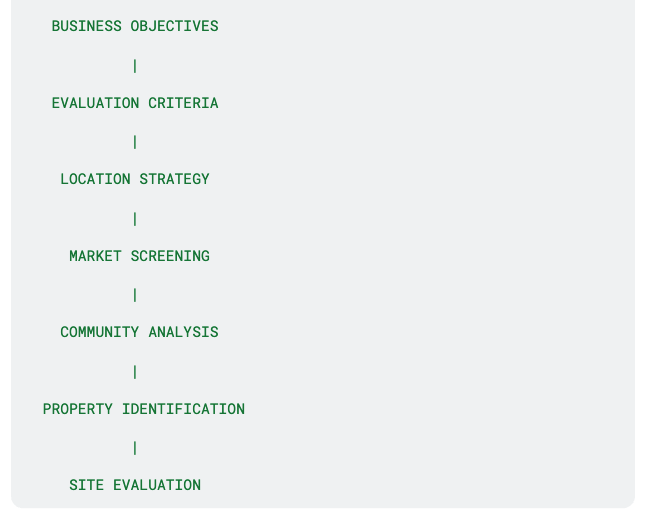
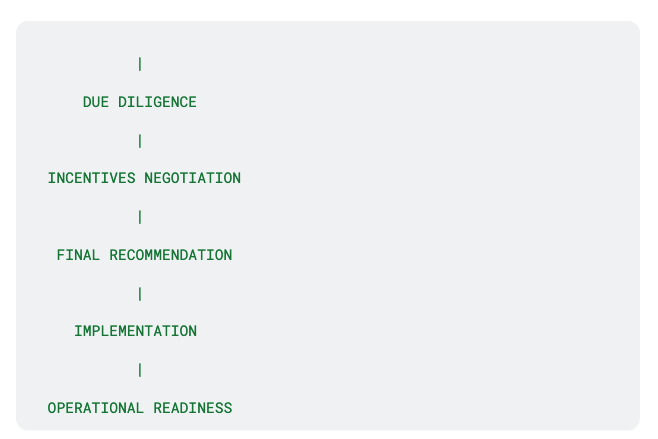
Two features of this sequence matter more than the steps themselves. Evaluation criteria are set before markets are compared, so the comparison cannot be shaped by whichever option arrived first. And incentives are negotiated after site evaluation, so they improve a decision already made on operational grounds rather than driving one.
Section 6: The Decisions That Matter Most
Framework pillars: All five
Most guides list criteria. Fewer address how executives should actually weigh them. These four questions do more work than any criteria list.
Which Factors Should Eliminate a Location Immediately?
Some constraints are not trade-offs. They are disqualifications, and treating them otherwise wastes months.
Utility capacity that cannot be delivered within your schedule. Not expensive to deliver. Cannot be delivered. If the substation is a thirty-month project and you need production in twenty-four, the location is out regardless of everything else.
A labor market that cannot supply your headcount at any reasonable wage. Wage premiums solve marginal shortfalls. They do not create workers who do not exist within a commuting shed.
Permitting pathways with genuine uncertainty of outcome. Long is manageable. Uncertain is not.
Environmental conditions that materially reduce buildable area below what the facility and its future phases require.
Regulatory or community opposition with a credible path to blocking the project.
Screening for eliminations first is faster and cheaper than scoring everything. A location that fails one of these does not need to be compared on the other twenty criteria.
Which Trade-Offs Are Worth Accepting?
Almost every real decision involves accepting something. The useful distinction is between trade-offs that stay constant and trade-offs that compound.
Generally acceptable: higher land cost in exchange for a better labor market. Longer construction timeline in exchange for the right configuration. Smaller incentive package in exchange for stronger utility position. Higher wages in exchange for lower turnover.
Generally not acceptable: lower operating cost in exchange for constrained expansion capacity. Faster occupancy in exchange for unvalidated utilities. Better incentives in exchange for a weaker labor market.
The pattern is that one-time costs are usually worth paying to avoid recurring ones, and recurring costs are worth paying to avoid structural limits.
Which Problems Can Be Solved After Opening, and Which Cannot?
Solvable after opening. Building layout and expansion within the footprint. Process and automation improvements. Supplier relationships. Local training partnerships. Most workforce development. Community relationships, with effort and time.
Not solvable after opening. The labor shed. Distance to suppliers and customers. Grid capacity in the region. Available land adjacent to your site. Climate and natural hazard exposure. State tax and regulatory environment. Transportation infrastructure.
The second list is the site selection decision. The first list is management.
What Decisions Are Almost Impossible to Reverse?
The geography itself, once construction begins. Utility service sizing, without significant cost and delay. Site configuration, once foundations are poured. The labor market you have committed to hiring from. Incentive obligations, once agreements are executed.
Decisions in this category deserve disproportionate analysis relative to their apparent size. A utility sizing decision made in an afternoon can constrain a facility for its entire life.
Section 7: Site Selection Criteria and How They Are Weighed
Criteria matter, but weighting matters more. Two companies evaluating identical locations with identical data reach different conclusions because they weight differently, and both can be right.
Operational criteria. Workforce. Utilities. Infrastructure. Transportation. Supply chain. Technology infrastructure. Future expansion capacity.
Financial criteria. Operating costs. Taxes. Incentives.
Risk criteria. Regulatory environment. Environmental factors. Business climate. Risk exposure including climate and hazard.
Human criteria. Housing. Quality of life. Executive relocation. Education and training. Community assets.
The fourth category is the one most often collected and least often weighted. Sections 9 and 10 address why that is a mistake.
Set weightings before scoring begins, and agree them across operations, finance, HR, and supply chain. Weightings established after results arrive are not criteria. They are rationalisation.
Section 8: Greenfield, Brownfield, or Existing Building
Framework pillars: Operational Fit, Future Fit
| Greenfield | Brownfield | Existing Building | |
|---|---|---|---|
| Speed to production | Slowest | Variable | Fastest |
| Initial investment | Highest | Moderate, with remediation exposure | Lowest |
| Configuration control | Complete | Constrained | Most constrained |
| Utility position | New service, longest lead time | Often existing, may be sized for a prior use | Existing, may be inadequate |
| Environmental risk | Lowest | Highest | Moderate |
| Expansion flexibility | Best | Variable | Usually limited |
| Best for | Specific process requirements, long horizon, geographic repositioning | Existing infrastructure and location advantage that outweighs remediation | Speed, or when the operation fits an available envelope |
The most common error here is choosing an existing building for speed and discovering that the utility service was sized for a different kind of operation, at which point the speed advantage disappears entirely.
Section 9: The Human Factors That Determine Long-Term Success
Framework pillar: Workforce Fit, Community Fit
Location analyses are strong on infrastructure and weak on people, which is strange given how many projects struggle for human reasons rather than technical ones.
A facility can have excellent power, ideal logistics, and a workable labor market, and still underperform because the leadership team it needs will not move there, or moves and leaves within two years.
These questions belong in the evaluation, not in an HR conversation afterward.
Can executives actually relocate there? Not whether they can be required to. Whether they will accept, and stay. The answer depends on housing at the right level, commute, and whether the region reads as somewhere to build a life rather than serve a posting.
Will spouses find employment? This is among the most common causes of failed executive relocation, and it is rarely modeled. A market with one dominant industry may have no realistic path for a spouse with a professional career.
Are there international schools? For international manufacturers transferring leadership with families, the availability of an international or IB-curriculum school within reasonable distance can determine whether a transfer is viable at all.
Is there an airport with the connections you need? Direct international flights matter enormously for companies whose leadership travels to headquarters regularly. A location requiring two connections each way changes how often senior people visit, which changes how well the facility is supported.
Will your leadership team enjoy living there? An uncomfortable question that predicts retention better than compensation does.
Can you recruit senior talent from outside the market? Every facility eventually needs to hire a plant manager, a quality director, or an engineering lead who is not already local. Some markets attract those candidates. Others cannot, and the operation is permanently limited to local supply.
Does the community embrace international employers? Some regions have decades of experience with foreign-owned manufacturing. Others do not, and the difference shows up in permitting, in hiring, and in how local leadership responds when something goes wrong.
Will employees relocate willingly? If the project involves transferring existing staff, their acceptance rate is a real input. Assumed transfers that do not happen become unplanned hiring in an unfamiliar market.
Section 10: Community Fit
Framework pillar: Community Fit
Quality of life data describes a place. Community fit describes the relationship between that place and your specific company, and it is a different assessment.
Does the community understand your industry? A region with existing advanced manufacturing knows what a plant needs, how to permit it, and what the workforce requirements look like. A region without that experience will be learning alongside you, and the learning happens on your timeline.
Is there a history of supporting foreign investment? Communities with established international employers have processes, relationships, and expectations already in place. First-time host communities are frequently enthusiastic and equally frequently slower.
Will local leadership collaborate? Access to decision-makers, responsiveness during permitting, and willingness to solve problems jointly vary enormously and are rarely visible in published data. Site visits are the only reliable way to assess this.
Are educational institutions aligned with your workforce needs? A technical college willing to build a program around your requirements is worth more than one with a large general enrollment. The question is not whether institutions exist but whether they will adapt.
Does the business culture match your operating style? Decision-making pace, formality, directness, and expectations around relationship-building differ across U.S. regions more than most international entrants anticipate. Misalignment here does not stop a project. It makes every subsequent interaction slower.
Section 11: The Overlooked Factors That Separate Successful Projects From Costly Ones
These rarely appear in a standard evaluation. They appear reliably in post-mortems.
Community acceptance of international companies. Not opposition. Familiarity, and the smoother processes that come with it.
Executive relocation experience. Whether the region has absorbed transferred leadership before, and whether the support infrastructure exists.
Spousal employment opportunities. The most common unmodeled cause of failed transfers.
International air access. Frequency, directness, and reliability of connections to headquarters.
Local leadership collaboration. Whether officials solve problems with you or process applications at you.
Utility redundancy, not just capacity. Adequate capacity on a single feeder with no alternate path is a different risk profile from the same capacity with redundancy.
Long-term climate resilience. Water availability trends, heat and cooling load trajectory, flood and storm exposure over a facility's operating life rather than its insurance term.
Future labor pipeline. Demographic trajectory and school enrollment tell you about the workforce in fifteen years. Current unemployment tells you about last month.
Supplier ecosystem maturity. Whether a supply base exists, or whether you will be building one while also building a plant.
University and technical college partnerships. Whether institutions will co-develop curriculum, and whether they have done it before.
Cultural alignment between headquarters and the U.S. workforce. Reporting expectations, decision-making authority, and communication norms. Misalignment here produces turnover that looks like a compensation problem and is not.
Section 12: Questions Great Executive Teams Ask
The quality of a location decision correlates closely with the quality of the questions asked before it is made.
If incentives disappeared tomorrow, would we still choose this location? The single most clarifying question in site selection. If the answer is no, incentives are driving the decision, and the location will still be there long after the benefit period ends.
What assumptions are we making, and which have we tested? Most projects rest on three or four load-bearing assumptions about demand, labor, or utility timing. Naming them is the first step toward testing them.
Which decision here will be hardest to reverse? Sequence your analysis by irreversibility rather than by cost.
What happens if labor costs increase by twenty percent? And separately: if freight increases, if energy increases, if the labor market tightens because a competitor announces nearby. Sensitivity testing is what distinguishes a model from a forecast.
Could this community support our next facility as well as this one? If the answer is yes, phase two is an expansion. If no, phase two is a second site selection project with duplicated overhead.
Are we optimizing for today's costs or tomorrow's competitiveness? These frequently point in different directions, and the answer should be a deliberate choice rather than a default.
Who on our team has actually spent time in the finalist communities? Data does not capture responsiveness, attitude, or whether a place feels like somewhere your people will stay.
Part Three: After Site Selection
Section 13: Implementation and Operational Readiness
Framework pillars: Operational Fit, Community Fit
The decision is the beginning of the work rather than the end of it. Projects that treat announcement as the finish line routinely lose the value of the analysis during execution.
Implementation. Governance and decision rights. Permitting and approvals. Utility coordination and delivery. Design and construction management. Vendor selection and local partnerships.
Leadership transition. Relocation logistics, visa timelines where applicable, housing and schooling, and the support that determines whether transferred leaders stay past year two.
Workforce ramp-up. Hiring against a plan built on the labor market you actually chose, training partnerships activated early, and realistic assumptions about how fast a plant staffs.
Community integration. Relationships with local officials, schools, and workforce organizations, built before you need them rather than during the first difficulty.
Operational readiness. Utilities energized and tested. Permits in hand. Equipment commissioned. Suppliers onboarded. Production ramp planned against realistic curves.
Two workstreams determine most schedules, and both trace directly back to the location decision. Utility delivery runs on the provider's timeline. Hiring runs on the labor market you selected.
Part Four: Learning From Others
Section 14: Five Decisions Companies Regret Five Years Later
Selecting a location based primarily on incentives. The benefit period ends. The operating cost structure does not. Companies in this position describe it the same way: the incentives were real, and they stopped mattering in year six of a thirty-year facility.
Choosing the lowest-cost labor market without considering retention. The wage advantage is visible immediately. The turnover cost arrives gradually, in rehiring, retraining, lost institutional knowledge, and quality variability. Many companies discover their effective labor cost exceeded the market they rejected.
Underestimating leadership relocation challenges. Key executives decline the move, or accept and leave within two years. The facility runs without the leadership it was designed around, and every subsequent hire is made from a market that was never assessed for senior talent.
Outgrowing a site because expansion was not planned. Phase two does not fit. The adjacent parcel sold. The utility service cannot scale. What should have been an expansion becomes a second site selection project, with duplicated overhead and split operations.
Failing to evaluate community compatibility. Nothing dramatic occurs. Permitting takes longer than peers experience. Workforce partnerships never quite materialize. Local relationships stay transactional. The facility functions, and everything is slightly harder than it needed to be, permanently.
The pattern across all five: each was a rational decision on the information used, and in each case the information excluded something that could not be fixed later.
Section 15: International Companies Expanding to the United States
Expansion priorities differ substantially by country of origin. The example below shows the structure we apply to each market.
Germany
Country overview. German manufacturers and technology companies typically view U.S. expansion as a route to customers, reduced supply chain risk, and advanced manufacturing capability near key markets.
Typical expansion goals. Serve OEMs and tiered suppliers in North America. Establish advanced manufacturing and engineering hubs. Reduce shipping cost and improve delivery times.
Common industries. Automotive and mobility. Industrial machinery. Advanced manufacturing and technology.
Typical challenges. Understanding regional labor market variation. Navigating incentive structures and state-level regulation. Adapting apprenticeship-based training models to U.S. institutions.
Site selection priorities. Skilled labor and training partners. Logistics connectivity to customers. Engineering talent availability.
Recommended services. Location Strategy. Site Selection. Workforce Analysis. Incentives Advisory. U.S. Landing Services.
We apply the same structure for China, Japan, South Korea, India, Taiwan, Canada, Mexico, Turkey, and other markets, and maintain country-specific resources for each.
Related: Foreign Direct Investment in the U.S. · International Manufacturing Expansion
Section 16: Why Organizations Work With Site Selection Consultants
Organizations engage a consultant when the cost of getting a location decision wrong is too high to accept, and when the alternative is coordinating a long list of disconnected vendors.
Independent advice. Objective analysis. Decision frameworks. Location analytics. Financial modeling. Labor market analysis. Risk assessment. Community coordination. Economic development engagement. Incentive negotiation. Project management. Implementation support.
WorldPoint Site Selection serves as an integrated expansion partner for manufacturing, industrial, and other capital-intensive projects. Our role is to help you make a better location decision rather than to sell you a particular site. We connect business strategy to location strategy, build transparent decision frameworks, apply location analytics and labor market analysis, coordinate with economic development organizations, and advise on incentives, risk, and implementation.
Brokerage activities, where required, are handled separately through CBREG True Team, so you remain fully compliant while strategy and analysis stay at the center of the decision.
Section 17: Frequently Asked Questions
What is site selection? The structured evaluation and comparison of locations to identify the community and property best supporting an organization's long-term business objectives, combining strategy, analytics, and risk management.
How is site selection different from commercial real estate? Site selection begins with business requirements and evaluates markets against them. Commercial real estate begins with available properties. Both are necessary, and confusing them is the most common structural error in expansion projects.
When should site selection begin? Once expansion becomes a serious strategic option, typically 18 to 24 months before production is needed. Early engagement preserves options that close quickly once timelines are committed.
What is the difference between location strategy and site selection? Location strategy identifies which regions best support the operation. Site selection identifies which specific property within those regions to occupy. Strategy comes first, and doing them in that order is what makes the property search efficient.
How many locations should be evaluated? Typically 50 to 100 markets at screening, narrowing to 10 to 20 for detailed review, then 3 to 5 finalists for visits and negotiation.
How long does site selection take? Most projects run 6 to 12 months from criteria definition to site control, with complex or multi-state searches taking longer. Due diligence and negotiation are frequently the extended phases.
What factors matter most? It depends entirely on the operation, which is why weighting matters more than the criteria list. For most industrial projects, workforce sustainability and utility capacity are the factors most likely to eliminate a location outright.
How should incentives influence the decision? They should improve the economics of a location that already works. If a location would not be chosen without its incentive package, the package is driving the decision, and the operating cost structure will outlast the benefit period.
What is usually overlooked? The human factors: executive relocation viability, spousal employment, air access, senior talent recruitment, and community compatibility. These derail projects regularly and appear in evaluations rarely.
What should we do before we start looking at buildings? Define business objectives, production requirements, utility loads, staffing plans, logistics flows, and investment criteria, then set and weight evaluation criteria. Looking at properties before this converts the search into a validation exercise.
How do international companies approach U.S. site selection differently? They carry additional workstreams: entity structuring, visa planning, supplier localization, and unfamiliar permitting and utility processes. These run parallel to the facility project and frequently take longer.
What happens after the site is selected? Implementation, leadership transition, workforce ramp-up, community integration, and operational readiness. Utility delivery and hiring are the two phases most often determined by the location decision itself.
Related Services
Manufacturing Expansion Services · Industrial Site Selection · Manufacturing Location Strategy · Workforce Analysis · Manufacturing Cost Analysis · Incentives Advisory · U.S. Landing Services · Manufacturing Feasibility Studies · Project Management Collaboration · Manufacturing Site Readiness Assessment · Manufacturing Insights
Make Better Site Selection Decisions
The best site is not always the one with the lowest costs, the largest incentives, or the newest industrial park. It is the one that strengthens your business for decades.
Successful expansion is not measured by where a facility is built. It is measured by how well that location supports your people, your operations, your customers, and your long-term strategy. Those things are decided long before construction begins, by the quality of the questions asked and the discipline of the process used to answer them.
WorldPoint Site Selection works with executive teams on exactly that. We bring structure, independent analysis, and experience across manufacturing and capital-intensive projects, and we stay involved from early strategy through operational readiness.