
Our Process
The Complete Manufacturing Expansion Guide: Strategy, Site Selection & U.S. Growth
U.S. Site Selection and Expansion Planning for Executive Teams
Executive Summary
Expanding manufacturing operations is one of the largest strategic investments a company will make. This guide sets out the complete decision process, from the first question of whether to expand at all through to production ramp-up, in the sequence executive teams actually work through it.
What This Guide Covers
The full manufacturing expansion lifecycle: feasibility, strategy, U.S. market entry, location strategy, workforce, supply chain, utilities, cost, incentives, site selection, due diligence, and implementation. Each section states the decision being made, the analysis required to make it, and the risk of skipping it.
Who Should Read It
CEOs and Presidents setting expansion direction and defending it to a board
COOs and Operations Leaders responsible for whether the facility performs once built
CFOs and Finance Teams modeling capital requirements and long-term returns
Corporate Development evaluating build, expand, and acquire alternatives
Site Selection and Real Estate Teams running the search
Private Equity and Investment Committees assessing portfolio company expansion
International Manufacturers planning a first or expanded U.S. presence
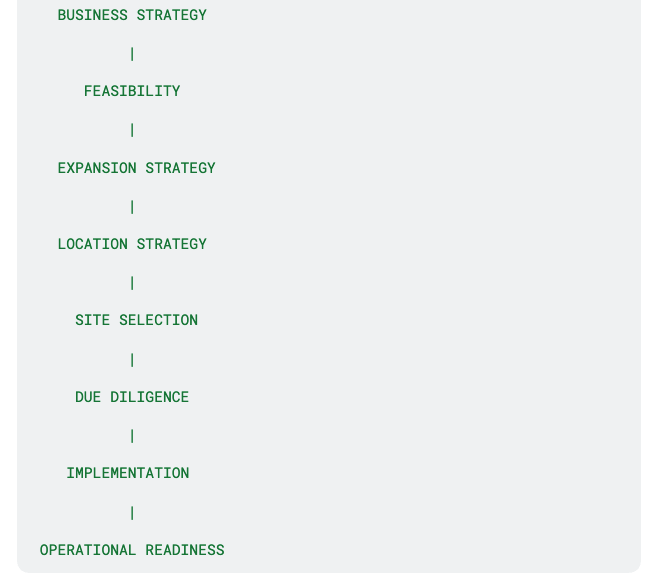
The Manufacturing Expansion Journey
Key Takeaways
Expansion decisions are won or lost upstream. By the time site selection begins, most of the cost and risk profile has already been fixed by decisions about geography, footprint, and scale.
Incentives should validate a location, never select one. A strong site with modest incentives outperforms a weak site with an aggressive package, and it does so every year for the life of the facility.
Utility capacity is now the most common hard constraint. Documented availability and deliverable capacity on your timeline are different things, and the gap between them is measured in years.
Labor is the constraint that surfaces last and hurts longest. Unemployment rates reveal almost nothing about whether a market can staff your operation against existing competition.
Total cost of ownership decides the outcome. The cheapest site to acquire is frequently not the cheapest site to run, and the difference compounds annually.
Sequence matters more than speed. Doing feasibility, strategy, and location work in order is what makes the site search efficient rather than exhaustive.
The decision is the starting point, not the finish line. Projects that treat site selection as the conclusion routinely lose the value of the analysis during implementation.
International market entry adds a layer, not just a location. Visa planning, supplier localization, and unfamiliar regulatory processes run parallel to the expansion itself.
Why WorldPoint
WorldPoint Site Selection is an independent U.S. industrial and corporate location strategy firm. We work with domestic manufacturers and with international companies establishing American operations.
Manufacturing specialization. Our depth is in industrial and manufacturing projects, which means we understand process loads, shift patterns, freight flows, and the operational realities that determine whether a location works.
Independent guidance. We do not market specific parks, properties, or communities, and we hold no commercial interest in where you land. Brokerage activities requiring a real estate license are handled separately through CBREG True Team.
Domestic and international experience. We support U.S. manufacturers and international companies entering the American market, where unfamiliar utility processes, labor markets, and permitting cultures carry outsized risk.
Long-term operational focus. A project can finish on time and on budget and still produce a facility that costs too much to run. We evaluate against decades of operation.
Integrated across the lifecycle. Strategy, analytics, site selection, incentives, workforce, economic development coordination, and implementation guidance sit within one team.
The WorldPoint Manufacturing Expansion Framework
Every engagement moves through six stages. The framework is what keeps a multi-year project coherent as stakeholders change and pressure builds.
| Stage | Question It Answers | Primary Output |
|---|---|---|
| 1. Discover | What are we actually trying to achieve? | Business case and requirements |
| 2. Evaluate | Is this viable, and in what form? | Feasibility findings and strategy |
| 3. Compare | Where should this go? | Regional shortlist |
| 4. Validate | Can this specific site deliver? | Due diligence and readiness findings |
| 5. Execute | How do we get it built? | Negotiation, transition, construction |
| 6. Operate | Does it perform as intended? | Ramp-up and ongoing performance |
Sections throughout this guide are mapped to these stages.
Table of Contents
Understanding Manufacturing Expansion
When Should Companies Expand?
Manufacturing Feasibility Studies
U.S. Market Entry Strategy
Manufacturing Expansion for International Companies
Manufacturing Expansion Strategy
Manufacturing Location Strategy
Workforce Analysis
Supply Chain Strategy
Utilities and Infrastructure
Manufacturing Cost Analysis
Taxes and Incentives
Market Screening
Manufacturing Site Selection
Facility Due Diligence
Executive Site Visits
Final Decision Framework
Transition Planning
Operational Readiness
Where Manufacturers Get Stuck
Common Manufacturing Expansion Mistakes
Manufacturing Expansion Timeline
Frequently Asked Questions
Section 1: Understanding Manufacturing Expansion
Framework stage: Discover
Executive Decision: What problem is this expansion actually solving, and is a new facility the right instrument for it?
Manufacturing expansion takes many forms, and the form follows the driver. Clarifying the strategic rationale before committing capital is what prevents a capacity problem from being solved with a geography answer, or a customer-service problem being solved with square footage.
Established Drivers
Organic growth. Increasing production to serve existing or growing demand.
Capacity constraints. Alleviating bottlenecks or overutilization at current facilities.
Reshoring. Moving production back to the United States to improve control, quality, or resilience.
Nearshoring. Locating production closer to key North American markets.
Customer requirements. Meeting proximity, lead-time, or service-level expectations.
Supply chain resilience. Diversifying footprint and suppliers to reduce concentration risk.
International expansion. Entering the U.S. market from abroad to access customers and talent.
Mergers and acquisitions. Integrating or rationalizing facilities after a transaction.
Emerging Drivers
Several forces have moved from peripheral to decisive within the last few years.
AI-driven manufacturing. Machine vision, predictive maintenance, and adaptive process control change compute, connectivity, and skills requirements at the facility level.
Automation. Higher automation shifts the cost base from labor toward power quality and technical trades, which changes what a good location looks like.
Electrification. Converting process heat and fleets from fossil fuels raises electrical demand substantially, so sites should be evaluated against the electrified configuration rather than today's.
Battery supply chains. Cell, module, and component investment continues to reshape regional supplier ecosystems and grid demand.
Semiconductor investment. Fab and supplier expansion is concentrating specialized labor and utility demand in specific corridors.
Domestic content requirements. Procurement rules and customer specifications increasingly reward U.S. production directly.
Customer localization. Major customers asking suppliers to co-locate has become a common expansion trigger in its own right.
Sustainability goals. Grid carbon intensity, water use, and freight emissions are now comparable across locations and reportable, which turns them into siting factors.
Common Mistakes: Treating an expansion as inevitable once it is proposed. Solving a throughput problem with a new facility when process improvement would serve. Allowing a single customer request to drive a decades-long capital commitment without testing it.
Related questions: What is manufacturing expansion? Why do manufacturers build new plants? What is reshoring? What is the difference between nearshoring and reshoring?
Related services:Expansion Advisory ·Location Strategy
Section 2: When Should Companies Expand?
Framework stage: Discover
Executive Decision: Is now the right moment, and is a new facility the right form of investment?
Timing is frequently the difference between an expansion that compounds and one that strands capital. Executives typically arrive at this question in one of six forms: should we expand, wait, relocate, consolidate, build, or acquire.
Trigger Categories
Business triggers. Market growth, new customer wins, product launches, or strategic repositioning.
Financial triggers. Margin pressure, cost competitiveness, capital availability, and ROI thresholds.
Operational triggers. Capacity constraints, quality issues, extended lead times, or aging assets.
Risk triggers. Geopolitical uncertainty, supply disruption, natural hazard exposure, or regulatory change.
Decision Framework: Build, Expand, or Acquire
| Build New | Expand Existing | Acquire | |
|---|---|---|---|
| Speed to production | Slowest | Fastest | Fast, subject to integration |
| Capital profile | Highest, phased | Moderate | High, front-loaded |
| Configuration control | Complete | Constrained by existing structure | Limited |
| Labor | New market, new hiring | Existing workforce, competitive market may be saturated | Inherited, with retention risk |
| Utility risk | New service, longest lead time | Incremental load on known service | Known, subject to headroom |
| Best when | Long horizon, specific requirements, geographic repositioning needed | Existing site has headroom and the market supports growth | Capability, capacity, or customers are the objective |
Executive Questions Before Feasibility: Should we expand now, or is waiting the better option? Build, expand, or acquire? What return threshold does this need to clear? What happens to the business if we do nothing for two years?
Common Mistakes: Deciding to build before testing whether the existing site has headroom. Treating acquisition as faster without modeling integration. Anchoring the timeline to a customer commitment made before feasibility work began.
Related questions: When should companies expand manufacturing? Should we expand or build a new facility? How do manufacturers decide between building and acquiring?
Related service: Manufacturing Feasibility Studies
Section 3: Manufacturing Feasibility Studies
Framework stage: Evaluate
Executive Decision: Is this expansion operationally, financially, and strategically viable, and in what configuration?
Feasibility work validates the concept before major capital is committed. It is the cheapest study a manufacturer commissions relative to what it can prevent, because a project stopped here costs a fraction of one halted after land acquisition, engineering, and utility commitments.
What a Feasibility Study Establishes
Business case validation. Alignment with corporate and customer strategy.
Demand. Market size, growth trajectory, and the firmness of customer commitments.
Capacity. Required throughput, equipment, and facility scale.
Financial analysis. Capital costs, operating costs, and projected returns.
Risk. Key uncertainties and available mitigation.
Scenario planning. Multiple production and footprint configurations tested against the same criteria.
Deliverables typically include a structured financial model, a qualitative risk assessment, and explicit go, no-go, and modify criteria.
Common Mistakes: Commissioning feasibility work after a preferred site has already emerged, which converts the study into a justification exercise. Modeling a single configuration. Treating a no-go finding as a failed study rather than a saved investment.
Related questions: What is a manufacturing feasibility study? What does a feasibility study include? When should feasibility be completed?
Related services: Manufacturing Feasibility Studies · Manufacturing Investment Strategy
Section 4: U.S. Market Entry Strategy
Framework stage: Evaluate
Executive Decision: Should we manufacture in the United States, and if so, in what form and at what scale?
For companies headquartered outside the U.S., establishing American production is a distinct strategic question that precedes location work. The answer shapes everything downstream, including how much facility is required, where it belongs, and what corporate and legal structure supports it.
Why Manufacturers Enter the U.S.
Customer proximity. U.S. customers increasingly expect domestic supply, shorter lead times, and local technical support. For automotive, aerospace, and industrial suppliers, co-location near a major customer is often the trigger rather than a benefit.
Tariffs and trade policy. Duty exposure on imported finished goods and components materially affects landed cost. Domestic production changes that calculation, and Foreign Trade Zone designation can change it further for operations that continue to import inputs.
Supply chain resilience. Concentration of production in a single region has moved from an efficiency to a board-level risk. North American capacity reduces exposure to transit disruption, port congestion, and geopolitical volatility.
Domestic content requirements. Procurement rules, customer specifications, and incentive eligibility increasingly reward or require U.S. manufacturing directly.
Market access and growth. The scale of U.S. industrial demand justifies local production for companies whose export volumes have outgrown a shipping model.
Nearshoring and reshoring dynamics. Companies relocating from Asia frequently evaluate U.S. and Mexican options together, weighing labor cost against logistics, tariff treatment, and proximity to end customers.
Common Market Entry Models
| Model | Typical Use | Considerations |
|---|---|---|
| Greenfield manufacturing | Long-term commitment, specific process requirements | Highest control, longest timeline, largest capital |
| Acquisition | Buying capability, capacity, or customer relationships | Faster entry, integration and cultural risk |
| Joint venture or partnership | Shared risk, local market knowledge | Governance complexity, alignment risk |
| Contract manufacturing first | Testing demand before committing capital | Lower risk, less control, harder to scale |
| Distribution before production | Establishing customer base ahead of manufacturing | Sensible sequencing, delays local content benefits |
| Regional headquarters plus plant | Combining commercial and production presence | Site requirements differ; often separate locations |
What Runs in Parallel
U.S. market entry involves workstreams that a domestic expansion never encounters, and they run alongside the facility project rather than after it.
Legal and corporate structure. Entity formation, tax structuring, and cross-border considerations.
Visa and immigration planning. Executive and technical staff transfers require lead time that frequently exceeds construction milestones.
Executive relocation. Housing, schooling, and family support determine whether key transfers succeed.
Supplier localization. Establishing or qualifying a U.S. supply base, which affects site location as much as customer proximity does.
North American distribution strategy. How the facility serves the U.S., Canada, and Mexico as a single market.
Regulatory differences. Environmental permitting, employment law, and safety regulation differ substantially from most home markets and vary by state.
Economic development introductions. State and local organizations are a meaningful resource for first-time entrants, and engaging them early shapes what becomes available later.
Executive Questions Before Market Entry: Does U.S. production serve our customers or only our tariff position? What scale justifies the investment? Which model matches our risk tolerance? Who from our team will actually be on the ground, and for how long?
Common Mistakes: Sizing the first U.S. facility to home-market assumptions about labor cost and availability. Underestimating visa timelines. Selecting a location for customer proximity without assessing whether a supplier base exists nearby. Assuming U.S. permitting resembles the home country process.
Related questions: How do international manufacturers enter the U.S. market? What is foreign direct investment in manufacturing? Should we build or acquire in the U.S.? How do tariffs affect manufacturing location decisions?
Related services:Foreign Direct Investment ·International Manufacturing Expansion to the U.S.
Section 5: Manufacturing Expansion for International Companies
Framework stage: Evaluate
Executive Decision: What does a successful U.S. entry look like for a company with our origin, industry, and objectives?
International manufacturers arrive with different objectives, different industries, and different challenges. The patterns below reflect what we see most frequently.
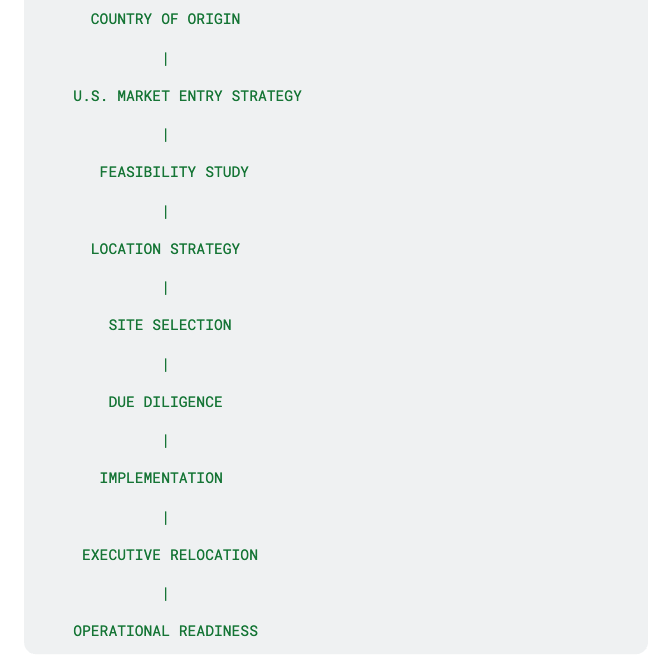
The International Manufacturer Journey
Country Expansion Matrix
| Country | Typical Expansion Goals | Common Industries | Primary Considerations |
|---|---|---|---|
| China | North American production, tariff mitigation | Automotive, electronics, consumer products | Supply chain localization, customer proximity, regulatory scrutiny |
| Japan | Customer proximity, long-term investment | Automotive, precision manufacturing, machinery | Workforce quality, infrastructure, long-horizon planning |
| South Korea | EV and battery expansion | Batteries, semiconductors, automotive | Power capacity, skilled labor, supplier clustering |
| Germany | Advanced manufacturing presence | Machinery, automation, automotive suppliers | Engineering talent, logistics, apprenticeship equivalents |
| Taiwan | Technology manufacturing | Semiconductor, electronics | Utility reliability, ultrapure water, supplier ecosystem |
| India | Market expansion and access | Pharmaceuticals, industrial manufacturing | Workforce growth, scalability, regulatory pathways |
| Canada | U.S. customer access | Food, industrial manufacturing, aerospace | Cross-border logistics, tariff treatment |
| Mexico | Nearshoring and integration | Automotive, aerospace, appliances | Supply chain integration, cross-border freight |
| Turkey | North American market entry | Industrial equipment, construction materials | Distribution strategy, port access |
| Italy | Specialty manufacturing presence | Machinery, food processing equipment, luxury goods | Skilled trades, customer proximity |
| France | Aerospace and industrial expansion | Aerospace, energy equipment, pharmaceuticals | Cluster access, engineering talent |
| United Kingdom | Market access, post-Brexit repositioning | Aerospace, pharmaceuticals, advanced materials | Regulatory alignment, talent transfer |
| Sweden | Advanced and sustainable manufacturing | Automotive, industrial equipment, batteries | Grid carbon intensity, engineering workforce |
| Switzerland | Precision and medical manufacturing | Medical device, pharmaceuticals, precision components | Cleanroom infrastructure, specialized labor |
| Netherlands | Distribution and advanced manufacturing | Semiconductor equipment, food processing, logistics | Port and inland connectivity |
| Vietnam | Diversification from concentrated production | Electronics, textiles, furniture | Cost structure, supply base development |
| Malaysia | Semiconductor and electronics presence | Semiconductor assembly, electronics | Utility reliability, technical workforce |
| Thailand | Automotive and electronics expansion | Automotive components, electronics, food | Supplier ecosystem, logistics |
| Singapore | Regional headquarters and advanced production | Pharmaceuticals, precision manufacturing, electronics | Talent transfer, corporate structuring |
| Brazil | North American market access | Aerospace, food processing, industrial | Logistics, regulatory navigation |
| Australia | Market access and resource-linked manufacturing | Mining equipment, food, medical | Distance management, distribution strategy |
Typical Challenges
Sizing. First U.S. facilities are frequently sized to home-market assumptions and prove either too small for demand or too large for the labor market to staff.
Labor market misreading. Wage differences between U.S. regions are wider than most entrants expect, and unemployment data is a poor proxy for availability.
Permitting culture. Process, timelines, and the role of public consultation vary substantially by state and municipality.
Utility procedures. Interconnection processes, cost responsibility, and lead times are unfamiliar and frequently underestimated.
Supplier localization. Qualifying a U.S. supply base takes longer than construction in many cases.
Retention of transferred staff. Executive relocation succeeds or fails on housing, schooling, and spousal employment as much as on compensation.
Related questions: How do foreign manufacturers build plants in the U.S.? What do international companies need to know about U.S. site selection? Which U.S. states attract the most foreign direct investment?
Related resources: Country-specific U.S. expansion guides for China, Japan, South Korea, India, Germany, Taiwan, Canada, Mexico, and Turkey.
Section 6: Manufacturing Expansion Strategy
Framework stage: Evaluate
Executive Decision: What are we building, where does it sit in our network, and how is it funded and sequenced?
Once feasibility is established, the strategy defines the shape of the investment.
Strategic planning. Connecting expansion to long-term corporate direction.
Growth objectives. Volume, revenue, market share, or service-level targets.
Capital planning. Investment phasing and funding strategy.
Customer strategy. Account priorities, service levels, and co-location requirements.
Production strategy. Which products and processes go where across the network.
Capacity planning. Initial build against future expansion, and long-term scalability.
Expansion sequencing. Order and timing of projects across multiple sites.
Executive alignment. Governance, sponsorship, and decision rights, agreed before disagreement becomes expensive.
Risk management. Strategic and operational risk identification and mitigation.
Long-term objectives. Cost position, resilience, sustainability, and innovation capacity.
Common Mistakes: Leaving governance undefined until a contentious decision forces it. Planning a single phase when the business case depends on a second. Allowing capital constraints to determine footprint before strategy has been tested.
Related service: Expansion Advisory
Section 7: Manufacturing Location Strategy
Framework stage: Compare
Executive Decision: Which region best supports this operation over the next twenty years?
Location strategy determines where a facility belongs before any specific site is evaluated. Getting the geography right first is what makes the property search efficient.
Location Strategy Against Site Selection
| Location Strategy | Site Selection | |
|---|---|---|
| Question | Where should this be? | Which property? |
| Scope | Nations, regions, states, metros | Communities, parks, buildings |
| Criteria | Strategic and market-level | Site-specific and technical |
| Output | Regional shortlist | Preferred site with terms |
The Location Strategy Funnel

Location strategy typically considers regions and multi-state corridors, state tax and regulatory environments, metros and labor sheds, community infrastructure, and the tradeoffs across cost, risk, and growth capacity.
Related service: Location Strategy
Section 8: Workforce Analysis
Framework stage: Compare
Executive Decision: Can we sustainably hire and retain the workforce this facility requires, over the next decade, in this market?
Labor is the most frequently underestimated constraint in manufacturing expansion, and the one that damages a project longest when misjudged.
What Gets Evaluated
Labor availability and genuine unemployment, not the headline rate
Labor quality and skill fit against your specific processes
Labor competition and wage pressure from existing and announced employers
Retention and turnover patterns in the local market
Future talent pipeline and demographic trajectory
Community colleges, technical schools, and their throughput
Universities and research partners
Training programs and available grants
Housing availability and affordability for your wage bands
Executive relocation considerations
Long-term labor sustainability across the facility's life
Industry Perspective
Automotive. Deep skilled trades requirement, high sensitivity to competing plants in the same labor shed. Semiconductor. Technicians with cleanroom experience are scarce and geographically concentrated. Battery. Rapid hiring at scale, frequently in markets without existing battery workforce. Aerospace. Certification and security requirements narrow the qualified pool considerably. Food processing. High-volume hiring with significant turnover exposure, so retention economics dominate. Medical device. Regulated environment demands documentation discipline as well as technical skill.
Workforce Checklist
☐ Labor availability within a realistic commuting shed
☐ Wage competitiveness against local employers, not national averages
☐ Labor pipeline from schools and training programs
☐ Housing availability at your wage bands
☐ University and technical college partnerships
☐ Historical turnover in comparable operations
☐ Competition from announced projects not yet hiring
☐ Demographic trend over ten years
International Expansion Considerations: The U.S. wage differentials between regions are wider than in most home markets. At-will employment, benefits expectations, and union environments vary by state. Transferred technical staff need visa lead time that frequently exceeds construction schedules.
Common Mistakes: Choosing a county because unemployment is high. Ignoring commuting patterns. Ignoring competition from projects announced but not yet hiring. Ignoring turnover. Ignoring housing.
Related questions: How do manufacturers compare labor markets? How much labor do manufacturers need? What causes manufacturing labor shortages? How do companies evaluate a labor shed?
Related services: Workforce Analysis · Landing Services
Section 9: Supply Chain Strategy
Framework stage: Compare
Executive Decision: Does this location strengthen our network, or only add capacity to it?
Expansion decisions should align with network design rather than being reconciled to it afterward. Once a plant is built, its position relative to suppliers and customers is fixed for the life of the asset.
Considerations include supplier proximity and clustering, transportation modes and costs, sea and inland ports, rail connectivity, air cargo access, inventory policy and buffers, resilience and multi-sourcing, network optimization and footprint design, distribution strategy, and customer proximity against service levels.
International Expansion Considerations: Supplier localization frequently takes longer than facility construction. Foreign Trade Zone designation can materially change landed cost for operations importing components. North American distribution should be planned as one market rather than three.
Common Mistakes: Optimizing a single facility rather than the network. Underweighting inbound freight because outbound is more visible. Assuming a supplier base will follow.
Related service: Supply Chain and Logistics Strategy
Section 10: Utilities and Infrastructure
Framework stage: Compare and Validate
Executive Decision: Can this region deliver our power, water, and gas requirements today and five years from now, on our schedule?
Utility capacity has become the most common hard constraint in U.S. manufacturing expansion. Documented availability and deliverable capacity are different things, and the gap is measured in years rather than months.
What Gets Evaluated
Power capacity, reliability, and redundancy. Water availability and quality. Wastewater capacity and discharge requirements. Natural gas access and pressure. Fiber and telecom connectivity. Road access and traffic patterns. Industrial parks and shared infrastructure. Utility redundancy and backup. Future capacity for expansion. Site readiness and pre-development status.
Industry Perspective
Different processes create entirely different utility profiles, and a site that suits one can be unusable for another.
| Industry | Dominant Utility Requirement |
|---|---|
| Semiconductor | Extreme power demand, ultrapure water, exceptional power quality |
| Electric vehicle and battery | Very high electrical load, water for thermal management |
| Data-adjacent manufacturing | Power capacity competing directly with data center demand |
| Food and beverage | High water volume, significant wastewater strength |
| Pharmaceutical | Purified water systems, redundancy, validated utilities |
| Steel and glass | Natural gas volume and pressure, heavy power |
| General industrial | Balanced profile, sensitive to reliability and cost |
Utility Readiness Checklist
☐ Power capacity in MW confirmed against your load, in writing
☐ Delivery timeline and any upgrade requirement, with cost responsibility assigned
☐ Redundancy and historical reliability on the specific feeder
☐ Water supply capacity and quality
☐ Wastewater capacity for volume and effluent strength
☐ Natural gas pressure and firm capacity
☐ Fiber routing with genuine path diversity
☐ Road, rail, and port access verified for your freight profile
☐ Headroom for planned future phases
Common Mistakes: Assuming available power equals available capacity. Ignoring future expansion when sizing service. Ignoring redundancy. Validating utilities only after site control, which removes your negotiating position.
Related questions: How much power does manufacturing require? How do utilities affect site selection? What is utility readiness? Who pays for utility upgrades?
Related service: Manufacturing Site Readiness Assessment
Section 11: Manufacturing Cost Analysis
Framework stage: Compare
Executive Decision: Which location produces the lowest total cost of operating this facility across its life?
Cost analysis extends well past wages and rent into lifecycle economics. The cheapest site to acquire is frequently not the cheapest site to run.
The Financial Framework
| Layer | What It Covers | Why It Matters |
|---|---|---|
| Capital costs | Land, construction, equipment, infrastructure contribution | Visible early, weighted too heavily |
| One-time costs | Relocation, hiring, commissioning, qualification | Frequently omitted from comparisons |
| Operating costs | Labor, utilities, freight, taxes, maintenance, insurance | Compounds annually, decides the outcome |
| Lifecycle costs | Major maintenance, reinvestment, eventual expansion | Determines whether the site remains suitable |
| Total cost of ownership | All of the above across the operating horizon | The correct basis for comparison |
| Sensitivity analysis | How conclusions shift if wages, freight, or energy move | Tests whether the recommendation is robust |
| Risk adjustment | Probability-weighted exposure by location | Separates cheap from cheap-and-fragile |
Return on investment and payback are outputs of this structure rather than inputs to it.
Common Mistakes: Comparing capital cost while ignoring operating cost. Excluding freight and inventory carrying cost. Modeling a single scenario. Treating incentive value as certain rather than conditional.
Related questions: What is total cost of ownership in manufacturing? How do manufacturers compare operating costs across states? What costs are usually missed in site comparisons?
Related service: Manufacturing Cost Analysis
Section 12: Taxes and Incentives
Framework stage: Compare
Executive Decision: What is each incentive package genuinely worth to us after obligations, and does it change the ranking?
Incentives can improve project economics substantially. They should validate a location that already works rather than select one that does not.
Programs typically include state incentives such as tax credits, grants, and financing; local incentives and abatements; tax credits and exemptions; training grants and workforce support; infrastructure participation; and negotiated terms with economic development organizations.
The evaluation that matters covers eligibility, performance obligations, clawback exposure, timing of realization, and compliance cost. A package realized over ten years against tax liability you may not generate is worth considerably less than its headline figure.
International Expansion Considerations: Foreign-owned projects are eligible for most state and local programs, though some carry domestic content or employment conditions. Economic development organizations are frequently a first-time entrant's most useful local relationship, and engaging them early shapes what becomes available.
Common Mistakes: Letting incentives select the location. Accepting headline value without modeling realization. Agreeing performance commitments the labor market cannot support. Negotiating after site control has been established.
Related questions: How do incentives influence location decisions? What happens if we miss an incentive performance requirement? Should incentives drive site selection?
Related service: Incentives Advisory
Section 13: Market Screening
Framework stage: Compare
Executive Decision: Which markets deserve detailed evaluation, and which can we responsibly eliminate now?
Screening narrows many candidates into a defensible shortlist. Elimination is as valuable as identification, because it concentrates the expensive analysis where it can change the outcome.
The work involves building evaluation criteria aligned to strategy, developing a long list, screening down using data-driven filters, developing scorecards and indices, applying risk weighting across labor, utilities, logistics, and policy, and securing executive alignment on the resulting targets.
A typical funnel moves from 100 or more candidates, to roughly 50 passing initial screens, to around 20 receiving detailed review, to 10 advancing, to 5 finalists for site visits.
Related service: Location Strategy
Section 14: Manufacturing Site Selection
Framework stage: Compare and Validate
Executive Decision: Which specific location creates the greatest long-term operating advantage?
Site selection compares communities and properties within the markets strategy has already validated.
Greenfield Against Brownfield Against Existing Building
| Greenfield | Brownfield | Existing Building | |
|---|---|---|---|
| Timeline | Longest | Variable, often extended | Shortest |
| Configuration | Fully custom | Constrained | Most constrained |
| Capital | Highest | Moderate, with remediation risk | Lowest initial |
| Utility risk | New service, longest lead time | Often existing service, may be sized for prior use | Existing, may be inadequate |
| Environmental risk | Lowest | Highest | Moderate |
| Expansion room | Best | Variable | Usually limited |
The work covers evaluating communities and labor sheds, comparing property types, assessing industrial parks and pre-developed sites, and applying structured scoring and decision matrices.
Related service: Industrial Site Selection
Section 15: Facility Due Diligence
Framework stage: Validate
Executive Decision: Have we found anything that should change our decision, our price, or our timeline?
Due diligence reduces the risk of discovery after commitment, when options have narrowed and cost has risen.
Due Diligence Checklist
☐ Environmental assessments, Phase I and where indicated Phase II
☐ Engineering and structural review
☐ Utility capacity and reliability validated in writing
☐ Building systems and code compliance
☐ Zoning, permitting, and entitlement review
☐ Existing easements and encumbrances
☐ Floodplain and wetlands verification
☐ Expansion capability and future flexibility
☐ Neighboring uses and community development plans
☐ Infrastructure gaps and required improvements
Common Mistakes: Compressing due diligence to meet an announcement date. Accepting seller documentation without independent verification. Reviewing environmental conditions while skipping utility confirmation.
Related service: Facility Due Diligence
Section 16: Executive Site Visits
Framework stage: Validate
Executive Decision: Does what we have seen confirm or contradict the analysis?
Site visits validate assumptions and surface qualitative factors that data cannot capture, including how a community actually responds to a major employer.
Effective visits require prepared agendas and objectives, defined questions for local leaders, utility and infrastructure meetings, sessions with economic development organizations, meetings with workforce and training partners, community and housing tours, structured scoring of observations, and a formal comparison afterward while impressions are fresh.
International Expansion Considerations: Visits carry additional weight for first-time entrants, since they establish the relationships with utilities, officials, and training partners that will matter throughout construction and ramp-up. Allow more time than a domestic itinerary would require.
Section 17: Final Decision Framework
Framework stage: Validate
Executive Decision: Can we defend this recommendation to the board, and document why?
Structured frameworks help executives make and evidence final choices: consistent comparison of finalists, executive alignment sessions, board approval materials, risk matrices, scenario comparison, financial models with sensitivity testing, formal recommendation packages, and a documented decision trail.
Section 18: Transition Planning
Framework stage: Execute
Executive Decision: How do we protect the value of this decision through execution?
Transition planning bridges decision and operations through project governance, an implementation roadmap with milestones, executive and employee relocation planning, vendor introductions and local partnerships, and community integration.
International Expansion Considerations: Visa processing, housing, schooling, and spousal employment determine whether transferred leadership succeeds. These timelines run parallel to construction and frequently exceed it.
Related services: Landing Services · Project Management Collaboration
Section 19: Operational Readiness
Framework stage: Operate
Executive Decision: Can this facility reach full production on the schedule the business case assumed?
Readiness covers hiring plans and onboarding, training and skills development, utilities in service and tested, permits and regulatory approvals, equipment installation and commissioning, production ramp-up planning, supplier onboarding and logistics setup, and ongoing community engagement.
Two workstreams determine most ramp schedules, and both trace directly back to site selection. Utility delivery runs on the provider's timeline. Hiring runs on the labor market you chose.
Related service: Site Readiness
Section 20: Where Manufacturers Get Stuck
Certain obstacles recur across projects regardless of industry or scale.
Choosing between states. Two finalists score similarly and the team stalls. Usually this means the criteria were not weighted before scoring, so the tiebreaker becomes preference rather than analysis.
Utility delays. A capacity requirement meets a utility capital plan running on a different clock. This is the most common cause of multi-quarter schedule loss.
Labor shortages. Hiring targets meet a market already committed to existing employers, and the ramp curve extends well past the model.
Community politics. Local approval processes involve public consultation that a project team did not plan for and cannot accelerate.
Environmental issues. Wetlands, floodplain, or contamination findings reduce buildable area or add mitigation that changes the economics.
Power availability. Grid constraint in high-growth corridors, frequently competing with data center demand for the same capacity.
Executive disagreement. Governance was never formalized, so a contested decision has no defined owner.
Construction timelines. Trade availability and material lead times in a hot market extend schedules beyond the plan.
Section 21: Common Manufacturing Expansion Mistakes
Most expansion difficulties trace to avoidable decisions made early.
Choosing incentives over operations. Prioritizing short-term value over long-term operating fit, producing higher costs and turnover.
Ignoring labor. Underestimating competition or skill gaps, causing hiring delays and quality problems.
Power shortages. Selecting sites without validated capacity or lead times, forcing redesign or delay.
Poor logistics. Overlooking transportation constraints that raise cost and extend lead times.
No risk analysis. Failing to model disruption or policy change.
Weak due diligence. Skipping reviews that later drive unplanned capital requirements.
Poor executive alignment. Proceeding without clear governance, causing internal delay or reversal.
Incomplete financial modeling. Ignoring total cost of ownership, lifecycle costs, or sensitivity.
Late utility validation. Confirming capacity only after site control, which removes negotiating leverage.
No implementation planning. Treating the decision as the finish line rather than the start of execution.
Section 22: Manufacturing Expansion Timeline
Timelines vary by project scale and market conditions. What follows is a representative sequence with the parallel workstreams that determine whether it holds.
| Months | Phase | Executive | Consultant | Economic Development | Engineering and Utilities |
|---|---|---|---|---|---|
| 1 to 2 | Feasibility | Define objectives, approve study | Business case, demand and capacity analysis, financial model | Preliminary market data | Preliminary load estimates |
| 2 to 3 | Expansion Strategy | Approve strategy and capital plan | Capital and production strategy, phasing | Early informal contact | Requirements definition |
| 3 to 5 | Location Strategy | Review shortlist, align stakeholders | Market screening, long list to short list, criteria weighting | RFI responses, market packages | Utility capacity inquiries |
| 5 to 7 | Site Selection | Site visits, finalist review | Community comparison, scoring, preliminary negotiation | Site tours, incentive discussions | Preliminary engineering, utility studies |
| 7 to 8 | Due Diligence | Review findings, adjust terms | Coordination, risk assessment, model refinement | Permitting guidance | Environmental, geotechnical, utility validation |
| 8 to 10 | Negotiations | Approve terms, board submission | Incentive negotiation, term structuring | Agreement drafting, approvals | Utility agreements, cost allocation |
| 10 to 12 | Implementation Planning | Governance, sponsorship | Transition planning, readiness | Workforce program setup | Design development, permit applications |
| 12+ | Construction and Ramp-Up | Milestone oversight | Continuity support | Training delivery, community integration | Construction, commissioning, utility energization |
The critical path usually runs through utilities and permitting rather than construction. Both begin earlier than most schedules assume.
Section 23: Frequently Asked Questions
What is manufacturing expansion? The process of increasing production capacity through a new facility, expansion of an existing one, relocation, or acquisition, driven by demand, capacity, resilience, or market access objectives.
How long does manufacturing expansion take? Most projects run 12 to 24 months from feasibility to construction start, with large or complex facilities taking longer. Utility and permitting timelines are usually the binding constraint.
What comes before site selection? Feasibility, expansion strategy, and location strategy. Site selection is efficient only once the geography has been narrowed on strategic criteria.
What is a manufacturing feasibility study? An evaluation of whether a proposed expansion is operationally, financially, and strategically viable before major capital is committed.
How do manufacturers compare locations? Using weighted scorecards, decision matrices, total cost of ownership models, and scenario and sensitivity analysis, applied identically across every candidate.
What factors matter most in location decisions? Workforce sustainability, utility capacity, logistics, and total operating cost, weighted according to what the operation actually consumes.
How do incentives influence decisions? They should improve the economics of a location that already works. A strong site with modest incentives generally outperforms a weak site with an aggressive package.
How much power should manufacturers plan for? Enough for the electrified, fully expanded configuration rather than the day-one load. Sizing to current requirements is a common and expensive error.
How do companies compare labor markets? By assessing availability within a realistic commuting shed, skills fit, wage competition from existing and announced employers, turnover history, and demographic trajectory.
What is total cost of ownership? The complete cost of operating a facility across its life, including capital, labor, utilities, freight, taxes, maintenance, and lifecycle reinvestment.
What is market screening? The structured narrowing of a broad candidate list to a defensible shortlist using criteria aligned to business strategy.
What happens during due diligence? Environmental, engineering, utility, title, zoning, and permitting verification on finalist sites before commitment.
How many sites should be evaluated? Typically 50 to 100 markets at screening, narrowing to 10 to 20, then 3 to 5 finalists for detailed evaluation and visits.
Should companies expand an existing facility or build new? It depends on headroom at the current site, the local labor market's capacity to absorb growth, utility availability, and whether the network benefits from geographic repositioning.
How do international manufacturers expand into the U.S.? Through greenfield construction, acquisition, joint venture, contract manufacturing, or a distribution-first sequence, each carrying different speed, control, and risk profiles.
What industries benefit most from formal site selection? Those with high capital intensity, significant utility demand, specialized labor requirements, or complex logistics, including automotive, battery, semiconductor, aerospace, food processing, and medical device.
When should a site selection consultant be engaged? Before location criteria are set, ideally during or immediately after feasibility. Engagement after a preferred site has emerged limits the value to validation.
About WorldPoint Site Selection
WorldPoint Site Selection is a U.S.-based industrial and corporate location strategy firm focused on manufacturing and industrial site selection, location analytics, and economic development incentive negotiation. We support domestic manufacturers and international companies planning and executing U.S. expansions.
WorldPoint provides integrated support across strategy, analytics, site selection, incentives, workforce, economic development coordination, housing and relocation connections, vendor introductions, and implementation guidance. The emphasis is on reducing long-term operating cost and risk rather than finding an available building or maximizing incentives. Brokerage activities requiring a real estate license are handled separately through CBREG True Team, while WorldPoint remains focused on strategic expansion, location decisions, and implementation support.
Service Pages
Manufacturing Feasibility Studies · Expansion Advisory · Location Strategy · Industrial Site Selection · Manufacturing Workforce Analysis · Supply Chain and Logistics Strategy · Manufacturing Cost Analysis · Incentives Advisory · Manufacturing Site Readiness Assessment · Facility Due Diligence · Project Management Collaboration · U.S. Landing Services
Resource Pages
U.S. Manufacturing Site Selection · Manufacturing Infrastructure and Site Readiness · Manufacturing Insights · Site Selection Checklist · Manufacturing Operating Cost Strategy · Manufacturing Location Analysis · Manufacturing Investment Strategy
International Expansion
Foreign Direct Investment in the U.S. · International Manufacturing Expansion to the U.S. · Country guides: China, Japan, South Korea, India, Germany, Taiwan, Canada, Mexico, Turkey
Industry Pages
Automotive · Electric Vehicle · Battery · Semiconductor · Aerospace · Food and Beverage · Medical Device · Distribution and Logistics
Get Started With Your Project Today
Use this guide to clarify your expansion strategy, compare locations with confidence, and plan a realistic timeline for your next facility.
Engaging early gives you a defensible shortlist, a total cost comparison built on consistent criteria, constraints identified while alternatives remain open, and a recommendation your board can act on.
If you are ready to discuss specific requirements, contact WorldPoint Site Selection, and we will outline what an engagement would involve for your project.