
Our Process
Site Selection Process: A Step-by-Step Guide
Manufacturing Site Selection Process: A Step-by-Step Guide
A manufacturing site decision will shape your costs, workforce, supply chain, and risk profile for decades. You only get one chance to choose the right location, and guesswork is expensive. You need a clear site selection process that turns uncertainty into confident, data-backed decisions.
Definition: The manufacturing site selection process is a structured method used to identify, evaluate, compare, and select the best location for a manufacturing facility based on workforce, infrastructure, operating costs, supply chain access, utilities, incentives, and long-term business goals.
On this page, you'll learn how the site selection process works, what steps manufacturers follow, what to analyze before choosing a site, how to compare locations, and when and why to work with a manufacturing site selection consultant.
Manufacturing Site Selection Process at a Glance
| Step | Stage | Goal |
|---|---|---|
| 1 | Define Business Objectives | Establish why the facility is needed and what success looks like |
| 2 | Establish Site Selection Criteria | Translate objectives into weighted, measurable evaluation factors |
| 3 | Identify Candidate Regions | Narrow the U.S. map to regions that can support the operation |
| 4 | Screen Communities | Reduce regions to a manageable shortlist for site visits |
| 5 | Evaluate Sites | Analyze workforce, utilities, logistics, cost, and risk site by site |
| 6 | Perform Due Diligence | Verify technical, legal, and regulatory conditions on finalists |
| 7 | Compare Finalists | Apply scorecards and decision matrices to expose tradeoffs |
| 8 | Select Preferred Location | Negotiate, secure approvals, and commit to the site |
The Process in Sequence
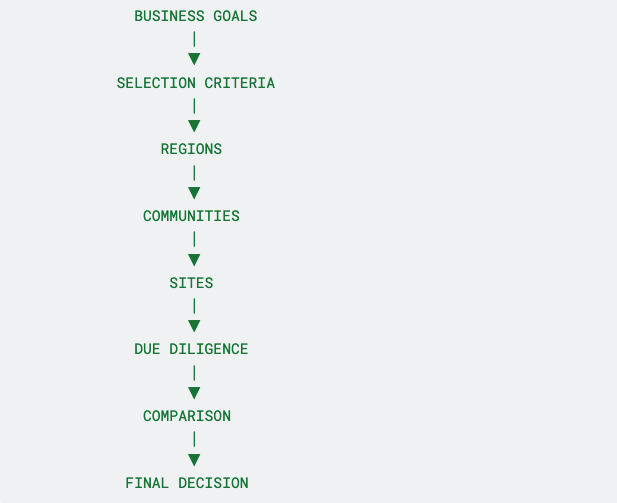
Each stage narrows the field. Each stage also raises the cost of reversing a decision, which is why the early steps deserve more time than they usually get.
Why Manufacturers Follow a Structured Site Selection Process
Definition: A structured process exists because manufacturing location decisions are long-term, capital-intensive, and difficult to reverse.
Manufacturing locations are long-term investments. A plant built today will likely operate for twenty to forty years. Every year of that horizon is influenced by decisions made before construction begins: what you pay for power, how far your freight travels, whether you can staff a second shift, whether phase two fits on the same parcel.
Mistakes are difficult and expensive to reverse. Relocating a manufacturing facility means writing off capital, rebuilding a workforce, requalifying with customers, and absorbing months of disrupted production. The practical options after a poor site decision are to live with it or to pay twice.
The most damaging constraints surface late. Labor shortages, utility capacity limits, and logistics inefficiencies frequently do not become visible until after construction has started or, worse, after production has begun. A utility that documented "available service" during marketing may need thirty months and a new substation to deliver your actual load. A labor market that looked adequate on paper may already be fully committed to two existing plants. These are not obscure risks. They are simply invisible without deliberate investigation.
A structured process forces balance. Left informal, site decisions tend to be driven by whichever factor is loudest: an aggressive incentive package, an executive's regional preference, a compelling building. A disciplined method weighs cost, risk, workforce, infrastructure, and growth capacity against one another, so no single factor quietly decides the outcome.
Manufacturing Site Selection Consulting
Definition: Manufacturing site selection consulting provides independent, data-driven support to help manufacturers choose optimal U.S. locations for new plants, expansions, and relocations.
WorldPoint Site Selection helps industrial and manufacturing companies, including EV, battery, semiconductor, and advanced manufacturing projects, understand and execute a structured site selection process across the United States. We act as an independent advisor focused on your long-term operating performance rather than on selling a particular building or community.
Our methodology combines:
Clear business and location strategy definition
Data-driven regional and community screening
Detailed site evaluation across workforce, utilities, logistics, real estate, and risk
Structured comparison tools such as scorecards and decision matrices
Incentive strategy, negotiation support, and due diligence
We provide independent analysis, align stakeholders, and help you move from initial questions to a defensible site decision. Contact WorldPoint Site Selection to discuss your manufacturing project.
What Is the Manufacturing Site Selection Process?
Definition: The manufacturing site selection process is the step-by-step approach manufacturers use to narrow hundreds of potential locations down to one preferred site that best fits operational, financial, and strategic goals.
The process moves through eight core steps: defining business objectives, establishing site selection criteria, identifying candidate regions, screening communities, evaluating specific sites, performing due diligence, comparing finalists, and selecting the preferred location.
Along the way, you assess workforce, utilities, transportation, real estate options, taxes, incentives, operating costs, risk, and long-term expansion potential. A clear step-by-step approach moves your team from broad questions like "Where in the U.S. should we be?" to a specific location that fits your operational and financial targets.
Site Selection vs. Location Strategy vs. Site Evaluation
Location strategy: High-level decisions about which regions or countries you should operate in, how many facilities you need, and how your network should be structured.
Site selection: The process of narrowing from regions and communities down to specific sites and choosing the preferred location.
Site evaluation: The detailed analysis of individual sites against your criteria, including workforce, utilities, logistics, costs, and risk.
When Should the Site Selection Process Begin?
Definition: Manufacturers should begin the site selection process as soon as a new facility, expansion, or major relocation becomes a serious strategic option.
The process should start well before you outgrow current capacity or sign LOIs for properties. Common triggers include:
Greenfield projects: Launching a new plant to serve a region or new market
Plant expansions: Adding capacity that may exceed your current site's capabilities
International expansion: Entering the U.S. market from abroad, often with limited local knowledge
Capacity constraints and reshoring: Bringing production back to the U.S. or rebalancing your network
Mergers and acquisitions: Rationalizing overlapping facilities
New product lines: Launching products that require new technology, labor, or logistics configurations
Step 1: Define Business Objectives
Definition: Step 1 clarifies why you need a site, what success looks like, and how location decisions should support your broader business strategy.
Before you look at maps or buildings, define the business case driving the project:
Production requirements: Capacity, technologies, automation, and flexibility needs
Customers: Who you serve, where they are, and required service levels
Growth: Expected volume increases, product mix changes, and potential new markets
Budget: Capital expenditure limits, operating cost targets, and funding considerations
Timeline: Required start of production, ramp-up periods, and key milestones
Executive goals: Strategic priorities such as resilience, reshoring, sustainability, or proximity to R&D
Decision criteria: How tradeoffs between cost, speed, risk, and flexibility will be evaluated
Step 2: Establish Site Selection Criteria
Definition: Step 2 translates your business objectives into measurable criteria used to compare regions, communities, and sites.
Your criteria should be specific, weighted, and tied to operating performance.
| Category | Examples of Factors |
|---|---|
| Workforce | Availability, skills, wage levels, turnover, training resources |
| Utilities | Power capacity and reliability, natural gas, water, wastewater, rates |
| Transportation | Highway access, rail, ports, airports, intermodal facilities |
| Taxes | Property, income, sales/use taxes, abatements |
| Incentives | Grants, tax credits, training support, infrastructure support |
| Real estate | Available buildings, greenfield sites, zoning, site readiness |
| Operating costs | Labor, utilities, transportation, occupancy, insurance |
| Risk | Natural hazards, regulatory risk, permitting complexity |
| Suppliers | Proximity to key vendors, material lead times, redundancy |
| Customers | Time-in-transit, delivery costs, service reliability |
| Executive relocation | Housing, schools, amenities for leadership and key staff |
| Quality of life | Cost of living, healthcare, education, community fit |
Weighting Turns Criteria Into a Decision Tool
Not every criterion carries the same importance. Most manufacturers assign weights to factors such as workforce, utility capacity, logistics, and operating costs based on project priorities. This creates a more objective comparison between locations and reduces bias during the evaluation process.
Weighting also forces a useful conversation before data collection begins. When operations, finance, and supply chain each propose different weights, the disagreement is about strategy rather than about sites, and it is far cheaper to resolve at this stage than at the finalist stage.
Step 3: Identify Candidate Regions
Definition: Step 3 narrows the U.S. map into a short list of regions that can support your manufacturing and supply chain needs.
Regional screening focuses on:
States and multi-state regions: Based on labor pools, logistics, tax environment, and industry clusters
Infrastructure and transportation: Highway networks, rail corridors, ports, airports
Labor markets: Current and projected manufacturing workforce, competition for labor
Supplier clusters: Proximity to key vendors and complementary industries
Customer access: Service radius, time-in-transit, distribution requirements
Step 4: Screen Candidate Communities
Definition: Step 4 evaluates communities within target regions to create a manageable list for site visits.
A typical funnel:
100+ potential locations identified across regions
~50 communities pass initial data screens
~20 communities receive an RFI or more detailed review
~10 communities advance based on data and engagement
~5 communities become serious finalists for site visits
At this stage you compare labor markets, utilities, permitting environments, available sites and buildings, and community support.
Step 5: Evaluate Individual Sites
Definition: Step 5 conducts deep, site-specific analysis to understand how each candidate will perform for your operation.
Workforce analysis. Talent availability, skill mix, wage levels, commuting patterns, competition for labor, and training partners. Workforce Analysis
Utility analysis. Electric power capacity and reliability, natural gas, water and wastewater availability, redundancy, and long-term cost. Utility Evaluation
Transportation analysis. Highway access, truck routes, rail service, intermodal options, ports, and distance to suppliers and customers. Transportation Analysis
Real estate analysis. Existing buildings versus greenfield sites, site readiness, zoning, layout efficiency, and expansion potential. Manufacturing Site Readiness
| Option | Advantages | Considerations |
|---|---|---|
| Existing building | Faster timeline, lower initial capex, known infrastructure | Layout constraints, limited expansion, retrofit costs |
| Greenfield site | Custom layout, optimized flows, planned expansion | Longer timeline, more permitting and infrastructure work |
Operating cost analysis. Total cost of operation including labor, utilities, freight, occupancy, taxes, and incentives across a multi-year horizon.
Incentive analysis. Structure, reliability, and long-term value of incentives, evaluated without letting them drive the decision.
Risk analysis. Environmental, regulatory, permitting, natural hazard, and community risks that could affect operations or timelines.
Step 6: Perform Due Diligence
Definition: Step 6 validates that your preferred sites truly meet technical, legal, and regulatory requirements before you commit.
Manufacturing site due diligence typically covers:
Environmental: Phase I and Phase II assessments, contamination risk, remediation needs
Geotechnical: Soil conditions, bearing capacity, foundation requirements
Title and legal: Ownership, easements, encumbrances, zoning compliance
Utilities: Detailed engineering confirmations, upgrade plans, and timelines
Permitting: Likely approvals, timelines, conditions, and costs
Expansion capability: Ability to add buildings, parking, or infrastructure later
Thorough due diligence extends further, into the conditions that most often produce late surprises:
Existing utility easements: Corridors crossing the site that constrain building placement or require costly relocation
Wetlands and protected habitats: Delineation status, mitigation requirements, and the buildable acreage that actually remains
Floodplain verification: Independent confirmation of flood zones and base flood elevations, rather than reliance on marketing materials
Existing environmental permits: Permits attached to the property, their conditions, and whether they transfer
Capacity commitments from utility providers: Written confirmation of deliverable load and delivery dates, distinct from documented service availability
Community development plans: Zoning changes, road projects, residential growth, or competing industrial announcements that could affect operations or labor competition later
That last group is where certified and heavily marketed sites most often diverge from expectations. Documentation confirms what exists. Due diligence confirms what it means for your project.
Step 7: Compare Finalists
Definition: Step 7 uses structured tools to compare your top locations and understand tradeoffs before selecting a site.
WorldPoint typically uses:
Weighted scorecards: Assign weights to criteria and score each site for an apples-to-apples comparison
Decision matrices: Visual grids comparing how each location performs on key drivers
Scenario planning: Test how each site performs under different volume, cost, or supply chain scenarios
Sensitivity analysis: See how changes in labor rates, freight costs, or incentives affect the ranking
Example: A Simplified Site Selection Scorecard
Three finalists, scored one to ten across five criteria:
| Criteria | Site A | Site B | Site C |
|---|---|---|---|
| Workforce | 9 | 7 | 8 |
| Utilities | 8 | 10 | 7 |
| Logistics | 10 | 8 | 8 |
| Operating Costs |
7 | 9 | 8 |
| Risk | 9 | 6 | 8 |
| Raw total | 43 | 40 | 39 |
On raw scores, Site A leads. But raw totals assume every criterion matters equally, and almost no project works that way.
Scenario 1: A labor-intensive assembly operation. Workforce and logistics dominate.
| Criteria | Weight | Site A | Site B | Site C |
|---|---|---|---|---|
| Workforce | 30% | 2.70 | 2.10 | 2.40 |
| Utilities | 25% | 2.00 | 2.50 | 1.75 |
| Logistics | 20% | 2.00 | 1.60 | 1.60 |
| Operating Costs |
15% | 1.05 | 1.35 | 1.20 |
| Risk | 10% | 0.90 | 0.60 | 0.80 |
| Weighted total | 8.65 | 8.15 | 7.75 |
Site A wins.
Scenario 2: A power-intensive process facility. Utility capacity and operating cost dominate.
| Criteria | Weight | Site A | Site B | Site C |
|---|---|---|---|---|
| Workforce | 15% | 1.35 | 1.05 | 1.20 |
| Utilities | 40% | 3.20 | 4.00 | 2.80 |
| Logistics | 15% | 1.50 | 1.20 | 1.20 |
| Operating Costs |
25% | 1.75 | 2.25 | 2.00 |
| Risk | 5% | 0.45 | 0.30 | 0.40 |
| Weighted total | 8.25 | 8.80 | 7.60 |
Site B wins.
Identical sites. Identical scores. Different answer. The weights, not the data, determine the outcome, which is why Step 2 deserves the attention it gets and why weighting should be agreed before scores are collected rather than after.
Scorecards support expert judgment. They do not replace it. Qualitative factors from site visits, community engagement, and stakeholder input belong alongside the numbers.
Step 8: Select the Preferred Location
Definition: Step 8 finalizes your choice, aligns leadership, and secures the site through negotiation and agreements.
Once you identify a preferred location, you move into:
Negotiations: Land or building price, incentive agreements, performance commitments
Property acquisition: Purchase and sale agreements or build-to-suit arrangements
Lease versus purchase decisions: Flexibility, control, and long-term cost
Incentive documentation: Formalizing grants, tax credits, and training support
Approvals: Board, investment committee, and internal sign-offs
Transition planning: Moving from site decision into design, permitting, construction, and staffing
Who Should Be Involved in the Site Selection Process?
Definition: Site selection is a cross-functional decision requiring input from operations, finance, technical, and external stakeholders.
Location decisions fail more often from missing perspectives than from missing data. A site that satisfies operations but not HR, or finance but not supply chain, will surface its problems later at higher cost.
| Role | What They Contribute |
|---|---|
| Executive leadership | Strategic priorities, risk tolerance, final decision authority |
| Operations | Production requirements, staffing models, shift patterns |
| Manufacturing engineering | Process loads, utility demands, layout and equipment needs |
| Supply chain | Inbound and outbound logistics, supplier proximity, freight cost |
| Finance | Capital budgets, operating cost models, incentive valuation, ROI |
| Human resources | Labor market feasibility, wage benchmarking, hiring ramp plans |
| Real estate | Property terms, lease versus purchase, acquisition process |
| Legal | Title, contracts, incentive agreements, compliance obligations |
| Environmental, health & safety | Permitting pathways, emissions, discharge, regulatory exposure |
| Economic development partners | Local data, incentive programs, community coordination |
| Site selection consultant | Independent analysis, structured methodology, negotiation support |
Involve manufacturing engineering and EHS early. Their requirements set the technical thresholds every other evaluation depends on, and discovering a process constraint at the finalist stage means restarting work already paid for.
What Happens After Site Selection?
Definition: Site selection concludes with a decision; project execution begins immediately afterward and typically spans one to three years.
The site decision is the start of the project rather than the end of it. Execution generally proceeds through:
Property acquisition — closing on land or building, finalizing title and survey
Incentive agreements — executing documentation and establishing compliance reporting
Utility coordination — formalizing service agreements, funding upgrades, scheduling delivery against your construction timeline
Facility design — architectural and engineering design against process requirements
Permitting — local, state, and federal approvals, frequently the longest pole in the schedule
Construction — sitework, foundations, building, and infrastructure
Equipment installation — process equipment delivery, installation, and commissioning
Workforce recruitment — hiring and training, beginning well ahead of production
Production ramp-up — qualification runs, yield improvement, and scaling to full rate
Two of these commonly determine the schedule and both trace directly back to site selection. Utility delivery timelines are set by the provider and the site, not by your project plan. Workforce recruitment depends on the labor market you selected, which is why the workforce analysis in Step 5 is a schedule input rather than merely a cost input.
Common Site Selection Mistakes
Definition: Common mistakes are pitfalls that increase risk and cost when choosing a manufacturing location.
Choosing incentives first: Letting incentives outweigh workforce, logistics, or utility realities
Ignoring utilities: Underestimating power, water, or wastewater constraints
Ignoring labor: Overlooking long-term workforce sustainability and competition
No expansion planning: Selecting sites with limited room or infrastructure for growth
Poor due diligence: Skipping environmental, geotechnical, or title reviews
Poor logistics: Focusing on plant costs while ignoring transportation and service impacts
How Long Does the Site Selection Process Take?
Definition: The site selection timeline varies by project complexity, but most manufacturing projects follow a phased process over several months.
Planning (4 to 8 weeks): Define objectives, criteria, and location strategy
Screening (4 to 8 weeks): Regional and community screening, initial shortlist
Community evaluation (4 to 6 weeks): RFIs, data collection, engagement with communities
Site evaluation (6 to 10 weeks): Site visits, technical evaluations, cost modeling
Due diligence (6 to 12 weeks): Environmental, geotechnical, title, permitting feedback
Negotiation (4 to 8 weeks): Incentives, property terms, internal approvals
Final selection: Executive decision and announcement
Why Manufacturers Hire Site Selection Consultants
Definition: Site selection consultants help manufacturers reduce risk, save time, and make better location decisions through specialized expertise.
Manufacturers work with consultants like WorldPoint when they need:
Independent analysis: Objective evaluation free from local biases or property interests
Market knowledge: Insight into labor markets, infrastructure, and incentive programs
Confidentiality: Protecting project identity and competitive information
Risk reduction: Systematic due diligence and risk assessment
Negotiation support: Experience structuring incentives and property deals
Time savings: Coordinating data, stakeholders, and timelines efficiently
WorldPoint Site Selection focuses on integrated expansion support: site selection, incentives strategy, workforce and labor analysis, economic development coordination, executive and employee relocation, vendor introductions, and practical operational guidance. Rather than managing multiple disconnected advisors, you work with one coordinated team.
Frequently Asked Questions
What is the site selection process?
A structured, multi-step method manufacturers use to identify, evaluate, and choose the best location for a facility. It begins with defining business objectives and criteria, then moves through regional and community screening, detailed site evaluation, due diligence, and final selection. A disciplined process reduces risk, avoids costly mistakes, and helps ensure the chosen site supports long-term operational performance.
What are the steps in manufacturing site selection?
Eight core steps:
1) Define business objectives
2) Establish site selection criteria
3) Identify candidate regions
4) Screen candidate communities
5) Evaluate individual sites
6) Perform due diligence
7) Compare finalists
8) Select the preferred location.
Each step builds on the previous one, narrowing the field from many options to a single, data-backed decision.
How long does site selection take?
Typically several months, depending on complexity and urgency. A straightforward project may move from planning to final selection in 6 to 9 months, while large, capital-intensive facilities can require 12 to 18 months or more. Starting early allows time for thorough evaluation, due diligence, and negotiations.
What is the most important factor when choosing a manufacturing site?
No single factor should drive the decision, but workforce is often the most critical. Strong labor availability, skills, and sustainable wage levels support long-term operations. Utilities, logistics, operating costs, and risk also play major roles. The best locations balance workforce strength with infrastructure, costs, incentives, and expansion potential.
Who should be involved in site selection?
Executive leadership, operations, manufacturing engineering, supply chain, finance, HR, real estate, legal, and EHS, supported by economic development partners and an independent site selection consultant. Cross-functional involvement prevents blind spots that surface expensively later.
What is the difference between site selection and location strategy?
Location strategy is the high-level plan for where your manufacturing network should be located, how many facilities you need, and what roles they play. Site selection is the project-specific process of choosing a particular site within that strategy.
What is site readiness?
Site readiness describes how prepared a property is for industrial development. A ready site typically has known environmental and geotechnical conditions, documented utilities and capacity, clear title, appropriate zoning, and defined permitting pathways. Manufacturers should ask for documentation and independent verification during due diligence.
How many locations should be evaluated?
Most projects start with 50 to 100 potential locations at the regional or community level, narrow to 10 to 20 using data, and finish with 3 to 5 finalists for detailed evaluation and site visits. Too few risks missing better options; too many overwhelms the team.
What is manufacturing due diligence?
The detailed verification process conducted on finalist sites before committing, including environmental assessments, geotechnical studies, title reviews, utility confirmations, and permitting analysis. The goal is to uncover issues that could delay construction, increase costs, or limit expansion.
What does a site selection consultant do?
Helps define objectives, develop location strategy, build criteria, gather and analyze data, screen regions and communities, evaluate sites, coordinate due diligence, and support negotiations, bringing market knowledge, independent analysis, and structured comparison tools.
What is a weighted site selection scorecard?
A tool that quantifies how well each location meets your criteria. You assign weights to factors such as workforce, logistics, utilities, and operating costs, then score each site against them. Because weights determine outcomes as much as scores do, they should be agreed before evaluation begins.
Should incentives drive the decision?
Rarely. Incentives can improve project economics but cannot fix poor workforce, weak infrastructure, or high-risk locations. Identify sites that meet operational needs first, then evaluate incentives as one component of total cost. A strong site with modest incentives usually outperforms a weak site with aggressive offers.
What information should be gathered before selecting a manufacturing location?
Data on workforce availability and costs, utility capacity and rates, transportation networks, real estate options, taxes, incentives, permitting timelines, and environmental or natural hazard risks, alongside clarity on production requirements, growth plans, and executive priorities.
What happens after a site is selected?
Property and incentive agreements are finalized, internal approvals secured, and the project moves into design, permitting, and construction. Utility and infrastructure upgrades are coordinated, hiring and training plans developed, and production ramped. Utility delivery and workforce recruitment are the two phases most often set by the site decision itself.
How do manufacturers compare multiple locations?
Using standardized data sets, weighted scorecards, decision matrices, and scenario and sensitivity analyses, examining performance on workforce, utilities, logistics, operating costs, risk, and incentives both individually and as part of the network. Site visits and stakeholder input add qualitative context.
How often should companies revisit their location strategy?
Every few years, or when major changes occur such as shifts in customer demand, supply chain disruption, regulatory change, or new technologies. Regular review keeps your footprint competitive and highlights where future site selection projects may be needed.
Conclusion
Manufacturing site selection is not a single decision—it's a structured process that transforms hundreds of potential locations into one confident, data-backed investment. Organizations that follow a disciplined methodology are better positioned to reduce risk, control long-term operating costs, and build facilities that support growth for decades.
Successful site selection requires balancing workforce, infrastructure, logistics, operating costs, incentives, and future growth. Every project is unique, and the right location depends on your specific goals and constraints.
Get Started With Your Project Today
WorldPoint Site Selection helps manufacturers navigate every phase of the process, from location strategy and criteria development through detailed site evaluation, due diligence, and negotiation. We partner with you to evaluate options, remove uncertainty, and keep your project on schedule.
Contact us to discuss your timeline and requirements.