
Our Process
Manufacturing Expansion Services
Strategic Advisory for Manufacturers Expanding, Relocating, or Establishing Operations in the United States
Expanding, relocating, or establishing manufacturing operations in the United States is one of the largest capital investments most manufacturers will make. The decision shapes cost structure, workforce, supply chain, and competitive position for decades.
WorldPoint is a strategic manufacturing consulting partner rather than a site selection company alone. We provide integrated expansion advisory that begins with your business strategy and continues through feasibility, location strategy, site selection, implementation, and operational readiness. Our focus is long-term operational success and total cost of ownership rather than near-term incentives or a single real estate transaction.
Executive Summary
Who This Service Is For
CEOs and Presidents setting expansion direction and defending it to a board
COOs and Operations Leaders accountable for whether the facility performs
CFOs and Finance Teams modeling capital requirements and long-term returns
Corporate Development Teams evaluating build, lease, and acquire alternatives
International Manufacturers planning a first or expanded U.S. presence
Private Equity Firms assessing portfolio company expansion or consolidation
Economic Development Partners supporting competitive projects
What WorldPoint Helps You Decide
Should we expand at all, and is now the right time?
Should we build, lease, or acquire?
Which U.S. regions best support our business?
How do we compare manufacturing locations objectively?
What will this actually cost to operate over twenty years?
How do we reduce expansion risk before capital is committed?
Our Integrated Expansion Framework
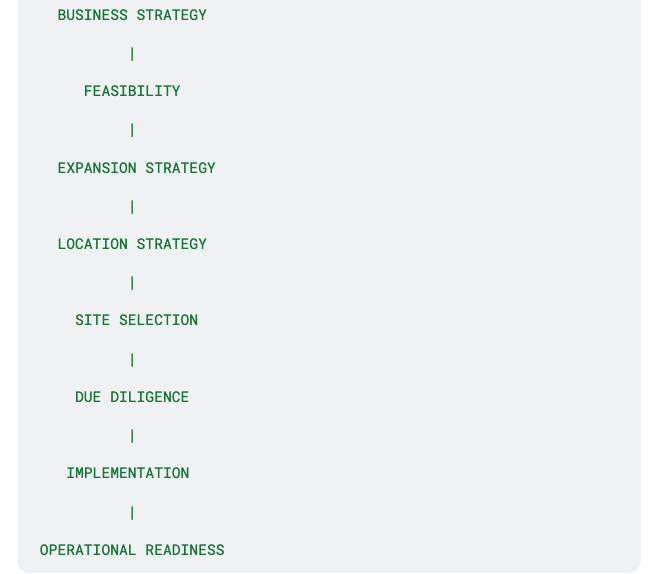
Successful expansions begin long before site selection. They start with clear business objectives, structured decision-making, and disciplined evaluation of where, when, and how to invest. Incentives and real estate opportunities matter, but only inside a long-term operational and financial framework.
When Manufacturers Typically Engage WorldPoint
Clients enter at different points in the lifecycle. The most common are:
Before approving capital investment, when the business case still needs testing
During feasibility work, to bring independent analysis to a go or no-go decision
Before selecting target states, so criteria are set before markets are compared
After narrowing a shortlist, to validate finalists and structure the comparison
During incentive negotiations, to assess what is genuinely attainable and what it obligates
Before acquiring an existing facility, to evaluate suitability, cost, and hidden risk
During implementation planning, to keep execution aligned with the original strategy
Before launching U.S. operations, particularly for first-time international entrants
Engaging earlier generally costs less and preserves more options. Engaging after a preferred site has emerged limits the work to validation rather than direction.
Manufacturing Expansion Is More Than Site Selection
Many manufacturers assume expansion begins with finding an available building or greenfield site. It begins with strategic planning and a clear understanding of how a new or expanded facility supports long-term business objectives.
We address the critical questions across every decision dimension.
Business strategy. Growth goals and revenue targets, production objectives and capacity requirements, market expansion priorities and customer proximity, competitive positioning, and planning for future phases.
Capacity planning. Current utilization and bottlenecks, future volumes and product mix, expansion timing and phasing, and growth projections by product, market, and region.
Investment analysis. Capital planning and funding strategy, ROI and payback expectations, financial modeling of alternative locations, and investment risk and sensitivity analysis.
Workforce planning. Labor availability and skills alignment, talent pipeline and training partnerships, wage and benefits structures, labor regulation, and executive relocation considerations.
Supply chain strategy. Supplier proximity and security, customer access and service levels, transportation networks and modal options, inventory strategy and working capital, and resilience.
Utilities and infrastructure. Power capacity, reliability, and cost. Water and wastewater requirements. Natural gas availability. Broadband and digital infrastructure. Transportation access. Future scalability.
Operating cost analysis. Labor, utilities and energy, taxes and regulatory costs, transportation and logistics, insurance and facility operating expense, and total cost of ownership across alternatives.
Risk assessment. Labor market volatility, political and regulatory environment, economic and sector exposure, construction cost and timeline risk, utility reliability, permitting and entitlement complexity, and environmental constraints.
Which Service Do You Need?
| If you are trying to... | Start with |
|---|---|
| Determine whether to expand at all | Manufacturing Feasibility Studies |
| Structure the project and sequence decisions | Manufacturing Expansion Advisory |
| Identify the best regions and states | Manufacturing Location Strategy |
| Compare specific properties | Industrial Site Selection |
| Understand whether a market can staff you | Workforce Analysis |
| Model what it will cost to operate | Manufacturing Cost Analysis |
| Assess and negotiate incentive packages | Incentives Advisory |
| Validate a shortlisted site | Site Readiness Assessment |
| Evaluate an existing building or brownfield | Facility Due Diligence |
| Keep implementation aligned with strategy | Project Management Collaboration |
| Establish first U.S. operations | U.S. Landing Services |
Our Manufacturing Expansion Services
Every client enters at a different stage. These services work individually or as a connected program.
Manufacturing Feasibility Studies
Executive Decision: Is this expansion viable, and in what configuration?
Purpose. Test the viability of a proposed investment before major capital is committed. Typical questions. Is this the right time to expand? Does the U.S. market justify a local plant? What production scale makes sense? Deliverables. Feasibility report, financial scenarios, go and no-go recommendations. When it is used. Early-stage planning and board-level decision-making.
Related: Manufacturing Cost Analysis, Expansion Advisory
Manufacturing Expansion Advisory
Executive Decision: How should this project be structured, sequenced, and governed?
Purpose. Provide strategic guidance across the entire expansion lifecycle. Typical questions. How should we structure the project? What milestones and decisions come next? Deliverables. Strategic roadmap, decision frameworks, executive briefings. When it is used. From concept through operational readiness.
Related: Location Strategy, Feasibility Studies
Manufacturing Location Strategy
Executive Decision: Which regions best support this operation over the next twenty years?
Purpose. Narrow from national or multi-region options to priority geographies. Typical questions. Which states or regions align with our workforce, logistics, and cost needs? Deliverables. Comparative location analysis, prioritized regional shortlist. When it is used. After feasibility, before detailed site selection.
Related: Workforce Analysis, Supply Chain Strategy, Manufacturing Cost Analysis
Industrial Site Selection
Executive Decision: Which specific location creates the greatest long-term operating advantage?
Purpose. Identify and evaluate sites and facilities meeting operational requirements. Typical questions. Which sites are viable? How do we compare them objectively? Deliverables. Site database, scoring models, comparative evaluation, recommendations. When it is used. Once preferred regions are defined.
Related: Site Readiness Assessment, Facility Due Diligence, Incentives Advisory
Workforce Analysis
Executive Decision: Can this labor market support our hiring, retention, and future workforce needs?
Purpose. Assess labor availability, skills, and competitiveness in target markets. Typical questions. Can we hire and retain the workforce we need? What will it cost? Deliverables. Labor market analysis, wage benchmarks, workforce risk assessment. When it is used. During location strategy and site selection.
Related: Manufacturing Cost Analysis, U.S. Landing Services
Supply Chain and Logistics Strategy
Executive Decision: Does this location strengthen our network, or only add capacity to it?
Purpose. Align facility location with suppliers, customers, and transportation networks. Typical questions. How will a new facility affect logistics cost and service levels? Deliverables. Network analysis, transportation cost modeling, supply chain risk mapping. When it is used. During feasibility, location strategy, and network optimization.
Related: Location Strategy, Manufacturing Cost Analysis
Manufacturing Cost Analysis
Executive Decision: Can this location deliver a sustainable operating cost advantage over the next ten to twenty years?
Purpose. Compare operating costs and total cost of ownership across alternatives. Typical questions. What will it actually cost to operate in each location? Deliverables. Detailed cost models, scenario comparisons, total cost of ownership analysis. When it is used. Throughout location strategy and final decision-making.
Related: Workforce Analysis, Incentives Advisory, Supply Chain Strategy
Incentives Advisory
Executive Decision: Should incentives influence our decision, or simply improve an already strong location?
Purpose. Evaluate, negotiate, and structure economic development incentives. Typical questions. What incentives are realistic? How should they influence our decision? Deliverables. Incentive forecasts, negotiation support, compliance roadmap. When it is used. During competitive project phases and before final decision.
Related: Manufacturing Cost Analysis, Location Strategy
Manufacturing Site Readiness Assessment
Executive Decision: Can this site actually deliver what our project requires, on our schedule?
Purpose. Confirm that candidate sites support current and future needs. Typical questions. Is the site truly ready? What are the hidden risks? Deliverables. Site readiness review, infrastructure and permitting assessment. When it is used. Shortlisted site validation.
Related: Facility Due Diligence, Industrial Site Selection
Facility Due Diligence
Executive Decision: Should this building change our decision, our price, or our timeline?
Purpose. Evaluate existing buildings and brownfield properties for risk and suitability. Typical questions. Can we adapt this facility? What will it cost and how long will it take? Deliverables. Facility assessments, improvement scopes, cost and timeline estimates. When it is used. When comparing existing buildings against greenfield options.
Related: Site Readiness Assessment, Manufacturing Cost Analysis
Project Management Collaboration
Executive Decision: How do we protect the value of this decision through execution?
Purpose. Coordinate stakeholders and keep expansion activities aligned. Typical questions. How do we keep strategy, site work, and implementation on track? Deliverables. Project plans, governance structure, coordination with vendors and economic development organizations. When it is used. Throughout the project, particularly during implementation.
Related: U.S. Landing Services, Expansion Advisory
U.S. Landing Services
Executive Decision: How do we establish and scale operations in an unfamiliar market?
Purpose. Help international manufacturers establish and scale first U.S. operations. Typical questions. How do we navigate U.S. regulations, employment practices, and local partners? Deliverables. Landing roadmap, local partner introductions, operational startup support. When it is used. For first-time or early-stage U.S. investments.
Related: Foreign Direct Investment, Workforce Analysis, Project Management Collaboration
Build, Expand, or Acquire
| Build New | Expand Existing | Acquire | |
|---|---|---|---|
| Objective | Purpose-built capacity in a chosen geography | Additional output at a proven location | Capability, capacity, or customers |
| Advantages | Full configuration control, optimal siting, planned scalability | Fastest to production, known utilities and workforce, lowest disruption to strategy | Immediate capacity, existing customers and staff |
| Challenges | Longest timeline, highest capital, new labor market | Site constraints, utility headroom limits, local labor may be saturated | Integration risk, inherited liabilities, cultural fit |
| Ideal when | Long horizon, specific process requirements, geographic repositioning needed | Existing site has room and the market supports growth | Speed matters, or the target holds something you cannot build |
Manufacturing Expansion for International Manufacturers
Why International Manufacturers Choose the United States
Establishing U.S. production is a strategic decision that precedes any location question. The reasons recur across markets and industries.
Access to North American customers. U.S. industrial demand is large enough to justify local production once export volumes outgrow a shipping model, and many customers now expect domestic supply with local technical support.
Supply chain resilience. Concentrating production in one region has moved from an efficiency question to a board-level risk. North American capacity reduces exposure to transit disruption, port congestion, and geopolitical volatility.
Tariff mitigation. Duty exposure on imported goods and components materially affects landed cost. Domestic production changes that calculation, and Foreign Trade Zone designation can change it further for operations still importing inputs.
Domestic manufacturing incentives. Federal, state, and local programs actively support new industrial investment, and foreign-owned projects are eligible for most of them.
Skilled workforce. Regional concentrations of manufacturing talent, technical colleges, and university research partners support advanced production, though depth varies considerably by market.
Stable legal environment. Predictable contract enforcement, property rights, and regulatory process reduce the risk attached to a multi-decade capital commitment.
Innovation ecosystems. Proximity to research institutions, suppliers, and technology partners supports product development alongside manufacturing.
Long-term market growth. Reshoring, infrastructure investment, and domestic content requirements continue to expand the addressable market for U.S.-based production.
International manufacturers must also navigate differences in labor practice, environmental and safety regulation, tax structure, incentive programs, and cultural expectation while competing for talent in dynamic regional markets. We support that through strategic planning, location analysis, market entry consulting, implementation, and long-term operational guidance.
Countries We Commonly Support
China:Typical objectives: Establish North American production, mitigate tariff exposure, localize supply for U.S. customers. Common industries: Electronics, consumer products, automotive components, industrial equipment. Common services: Market entry strategy, location and site analysis, incentives advisory, landing services.
Japan:Typical objectives: Support long-standing U.S. customers, shorten lead times, commit to long-horizon local investment. Common industries: Automotive, precision manufacturing, electronics, robotics. Common services: Location strategy, industrial site selection, workforce analysis, project management collaboration.
South Korea:Typical objectives: Expand EV and battery capacity, secure power and skilled labor, co-locate near cell and vehicle customers. Common industries: EV and battery manufacturing, semiconductors, electronics. Common services: Site readiness assessment, incentives advisory, location strategy, workforce analysis.
India:Typical objectives: Access the U.S. market directly, meet regulatory requirements for domestic supply, scale established export volumes. Common industries: Pharmaceuticals, specialty chemicals, industrial equipment, IT-enabled manufacturing. Common services: Feasibility studies, market entry strategy, location strategy, landing services.
Germany:Typical objectives: Expand North American production, reduce shipping cost, support automotive and industrial customers, improve delivery times. Common industries: Automotive, machinery, advanced manufacturing, industrial automation. Common services: Location strategy, industrial site selection, workforce analysis, incentives advisory.
Taiwan:Typical objectives: Establish U.S. technology manufacturing, secure utility reliability, build local supplier ecosystems. Common industries: Semiconductors, electronics, components, precision manufacturing. Common services: Site readiness assessment, utility and infrastructure evaluation, location strategy, landing services.
Canada:Typical objectives: Improve U.S. customer access, simplify cross-border logistics, manage tariff and trade exposure. Common industries: Automotive, food and beverage, forestry and building products, industrial manufacturing. Common services: Location strategy, supply chain strategy, industrial site selection.
Mexico:Typical objectives: Integrate North American production, serve U.S. customers directly, balance nearshore and onshore capacity. Common industries: Automotive, appliances, electronics, cross-border manufacturing. Common services: Supply chain strategy, location strategy, manufacturing cost analysis.
Turkey:Typical objectives: Enter the North American market, establish distribution alongside production, reduce transit times. Common industries: Automotive components, textiles, industrial goods. Common services: Market entry strategy, location strategy, landing services, incentives advisory.
Additional International Markets
We also support manufacturers from France, Italy, the United Kingdom, Switzerland, Sweden, the Netherlands, Belgium, Austria, Ireland, Vietnam, Thailand, Malaysia, Singapore, Indonesia, Australia, and Brazil, along with manufacturers worldwide expanding into the United States.
Our Manufacturing Expansion Process
Our process reduces uncertainty and provides a defensible path from concept through operational readiness.
Phase 1: Business Objectives. Define strategic goals, production objectives, market priorities, and investment criteria.
Phase 2: Feasibility Analysis. Test the economic, operational, and strategic viability of the proposed expansion.
Phase 3: Expansion Strategy. Structure the approach, phasing, scale, and timing against corporate strategy.
Phase 4: Location Strategy. Evaluate and prioritize regions and states on workforce, logistics, cost, and risk.
Phase 5: Operational Analysis. Deep evaluation of workforce, supply chain, utilities, infrastructure, operating costs, and incentives.
Phase 6: Industrial Site Selection. Identify, analyze, and compare candidate sites and facilities within preferred regions.
Phase 7: Due Diligence. Confirm site readiness, environmental and permitting conditions, infrastructure, and facility suitability.
Phase 8: Implementation Support. Coordinate with economic development organizations, permitting authorities, utilities, and project partners from decision through construction and startup.
Phase 9: Operational Readiness. Support workforce ramp-up, relocation, vendor onboarding, and compliance through launch.
Industries We Support
Expansion priorities differ substantially by sector. What follows is what typically drives the decision in each.
Automotive. Decisions center on supplier ecosystem depth, proximity to assembly customers, skilled trades availability, and logistics reliability for just-in-time delivery.
Electric vehicle manufacturing. Electrical capacity and delivery timelines dominate, alongside battery supply proximity and access to a workforce that rarely exists locally at the required scale.
Battery manufacturing. Very high power demand, significant water requirements for thermal management, rapid hiring at scale, and clustering near cell or vehicle customers.
Semiconductors. Power reliability and quality, ultrapure water availability, vibration and cleanroom considerations, advanced technical workforce, and long-term utility headroom.
Aerospace. Certification requirements, security clearance considerations, specialized supplier access, and skilled machinists with a narrow qualified pool.
Defense manufacturing. Security requirements, facility clearance considerations, domestic content compliance, and supplier chain traceability.
Medical device manufacturing. Cleanroom infrastructure, validated utilities, regulatory documentation discipline, and technical workforce with regulated-environment experience.
Pharmaceutical manufacturing. Purified water systems, utility redundancy and validation, environmental permitting complexity, and specialized technical labor.
Food and beverage processing. Water availability and quality, wastewater capacity for high-strength effluent, cold-chain logistics, and proximity to both suppliers and consumers.
Consumer products. Distribution economics, labor cost sensitivity, and flexibility to shift production as demand patterns move.
Plastics and polymers. Natural gas and electricity cost, resin supply logistics, and environmental permitting for emissions and process water.
Chemicals. Utility intensity, environmental and safety permitting, rail and pipeline access, and community engagement requirements.
Industrial equipment. Skilled fabrication and assembly labor, heavy haul access for oversize product, and supplier proximity for components.
Advanced manufacturing. Technical workforce depth, digital infrastructure, and proximity to research partners and equipment vendors.
Robotics. Engineering talent, integration partner ecosystems, and connectivity supporting development and testing.
Electronics. Component supply access, cleanroom and ESD requirements, and technical assembly workforce.
Distribution and logistics. Transportation network position, labor availability for high-volume operations, and building specifications supporting throughput.
Data centers and digital infrastructure. Power capacity above all else, fiber path diversity, water for cooling, and land with room to phase.
Who We Work With
Domestic manufacturers. Planning new facilities, expansions, and modernizations within the United States.
International manufacturers. Entering or expanding in the U.S. market with grounded expectations and local insight.
Private equity. Evaluating portfolio company expansion, consolidation, or greenfield strategies.
Corporate development teams. Aligning manufacturing investment with broader corporate and acquisition strategy.
Economic development organizations. Assessing readiness, refining value propositions, and supporting competitive projects.
Industrial developers. Aligning speculative and build-to-suit projects with manufacturer and investor requirements.
Commercial real estate partners. Supporting location analysis, workforce and cost evaluation, and objective site comparison.
Public sector organizations. Coordinating infrastructure, workforce, and incentive programs that support manufacturing growth.
Common Manufacturing Expansion Projects
First U.S. manufacturing facility. Existing plant expansion. Capacity expansion. Manufacturing relocation. Consolidation. Nearshoring. Reshoring. Greenfield development. Brownfield redevelopment. Multi-state evaluations. Multi-facility optimization. Supplier network expansion. Regional manufacturing hubs. International market entry.
Each requires a tailored blend of strategy, analysis, and implementation support to balance risk, cost, and long-term competitiveness.
Why Manufacturers Choose WorldPoint
Independent advice. Unbiased guidance rather than commission-driven recommendations.
Manufacturing expertise. Deep experience across core and advanced manufacturing sectors.
Integrated consulting. Strategy, feasibility, location, and site selection within one framework.
Long-term cost perspective. Focus on total cost of ownership rather than upfront incentives.
Data-driven analysis. Structured evaluation of workforce, cost, risk, and operations.
Domestic and international experience. Support for U.S.-based and global manufacturers.
Strategic continuity. Consistent guidance from early strategy through operational readiness.
Collaborative delivery. Coordination with your internal teams and external partners.
Objective decision framework. Clear criteria and scoring supporting defensible decisions.
Implementation support. Practical help executing decisions and ramping operations.
What Makes a Successful Expansion
Across projects, successful expansions share the same characteristics.
Clear business objectives established before any location is considered
Executive alignment on governance and decision rights, agreed before disagreement becomes expensive
Data-driven decision-making using consistent criteria across every option
Workforce planning grounded in the market's real capacity rather than headline statistics
Infrastructure validation completed in writing before site control
Long-term cost analysis covering total cost of ownership rather than capital cost alone
Structured site evaluation with weighted criteria set before scoring begins
Thorough due diligence conducted with enough time to act on the findings
Disciplined implementation that carries the original strategy through to production
The projects that struggle almost always skipped one of these, and usually under schedule pressure.
Frequently Asked Questions
Manufacturing Expansion
When should we start planning a manufacturing expansion? As soon as expansion becomes a serious strategic option, typically 18 to 24 months before you need production. Early planning preserves options that close quickly once a timeline is committed.
How long does a typical expansion project take from strategy to operation? Most projects run 12 to 24 months from feasibility to construction start, with production following. Utility and permitting timelines are usually the binding constraint rather than construction.
What information do we need before we begin site selection? Production requirements, utility loads, staffing plans, logistics flows, capital parameters, and target in-service date. Site selection without these evaluates markets against assumptions.
Manufacturing Investment
How do we evaluate whether a new facility is financially justified? Through feasibility analysis comparing build, expand, and acquire scenarios on total cost of ownership, with sensitivity testing on the assumptions the case depends on most.
What ROI thresholds do manufacturers typically target for expansions? Thresholds vary by sector, capital structure, and risk appetite. What matters more is that the threshold is agreed before options are compared, so it acts as a criterion rather than a justification.
Site Selection
How many locations should we evaluate in a competitive site selection process? Typically 50 to 100 markets at screening, narrowing to 10 to 20 for detailed review, then 3 to 5 finalists for visits and negotiation.
How do we compare sites objectively across multiple states? Using weighted scorecards with criteria agreed before scoring, consistent cost modeling, and structured risk assessment applied identically to every candidate.
Workforce
How do we know if a labor market can support our hiring needs? By assessing availability within a realistic commuting shed, skills fit against your processes, wage competition from existing and announced employers, and historical turnover.
What workforce risks should we consider before selecting a location? Competition from projects not yet hiring, housing availability at your wage bands, commuting patterns, demographic trajectory, and training pipeline capacity.
Operating Costs
What are the major cost drivers for a U.S. manufacturing facility? Labor, utilities, freight, taxes, and maintenance. Freight and inventory carrying cost are frequently larger than the labor and real estate differences that dominate site comparisons.
How do operating costs differ across U.S. regions? Substantially, and not always in the direction expected. Wage differences can be offset by utility rates, tax treatment, or freight position, which is why total cost modeling matters more than any single input.
Incentives
How should we factor incentives into our location decision? As one component of total cost, valued net of performance obligations. A strong site with modest incentives generally outperforms a weak site with an aggressive package.
What are common pitfalls in incentives negotiations and compliance? Accepting headline value without modeling realization, agreeing commitments the labor market cannot support, and negotiating after site control has already been established.
International Expansion
What are the biggest challenges international manufacturers face in the U.S.? Sizing the first facility to home-market assumptions, misreading regional labor markets, underestimating utility and permitting timelines, and the time required to localize a supply base.
How do we adapt our operating model to U.S. regulatory and labor environments? Through early engagement with local counsel, economic development organizations, and advisors familiar with state-level variation in employment law, environmental permitting, and safety regulation.
U.S. Market Entry
When does it make sense to build a U.S. plant versus serving the market from abroad? When customer expectations require domestic supply, when tariff exposure is material, when export volumes justify local production, or when domestic content requirements affect eligibility.
How do we prioritize U.S. regions for our first facility? By weighting customer proximity, supplier availability, labor market depth, utility capacity, and total operating cost against your specific requirements rather than general rankings.
Implementation
How do we structure governance and project management for an expansion? With defined decision rights, an executive sponsor, a clear escalation path, and agreement on which decisions require board involvement, all established before construction begins.
What should our critical path look like from site control to production? Usually permitting and utility delivery rather than construction. Both start earlier and take longer than most schedules assume.
Landing Services
What support is available for executive relocation and local vendor selection? Housing and schooling guidance, visa timeline planning, vetted local vendor introductions, and operational startup support.
How do U.S. landing services reduce risk for first-time investors? By shortening the learning curve on regulation, employment practice, and local relationships, and by providing continuity between the location decision and operational launch.
Additional questions typically address permitting, environmental review, infrastructure timelines, and integration with existing manufacturing networks.
Related Manufacturing Consulting Services
Services: Manufacturing Feasibility Studies ·Manufacturing Expansion Advisory ·Manufacturing Location Strategy ·Industrial Site Selection · Workforce Analysis · Supply Chain Strategy · Manufacturing Cost Analysis · Incentives Advisory ·Manufacturing Site Readiness Assessment ·Facility Due Diligence ·Project Management Collaboration · U.S. Landing Services
Resources:Manufacturing Insights · The Complete Manufacturing Expansion Guide ·U.S. Manufacturing Site Selection ·Manufacturing Infrastructure and Site Readiness
International:Foreign Direct Investment ·International Manufacturing Expansion to the U.S. · Country pages for China, Japan, South Korea, India, Germany, Taiwan, Canada, Mexico, and Turkey
Build Your Next Manufacturing Expansion on Better Decisions
Manufacturing expansion is rarely a single decision. It is a series of interconnected decisions that shape operating performance for years. Organizations that evaluate workforce, infrastructure, operating costs, supply chains, and long-term business objectives together are better positioned to invest with confidence and reduce project risk.
WorldPoint helps domestic and international manufacturers work through every stage with objective analysis, structured decision-making, and integrated consulting. Whether you are expanding an existing facility, entering the U.S. market for the first time, relocating production, or comparing multiple investment opportunities, we provide the guidance to move forward with confidence.
Tell us about your project requirements and timelines, and we will outline a tailored path forward.Contact WorldPoint Site Selection to begin.