
MANUFACTURING WORKFORCE · U.S. SITE SELECTION
Apprenticeships vs. Recruiting
in Manufacturing
Staff the launch.
Build the future workforce.
Manufacturing apprenticeships develop job skills through paid work, mentoring, and structured learning. Recruiting brings in existing technical and leadership experience. A blended talent pipeline connects both to the production schedule.
By WorldPoint Site Selection
First published October 1, 2026 · Updated October 14, 2026

Illustrative manufacturing training scene.
THE SHORT ANSWER
Should manufacturers use apprenticeships or recruiting?
Most manufacturing projects need both. Recruit experienced leaders and critical technical staff for the opening phase. Build apprenticeships and training partnerships for capabilities that must grow with the operation.
Recruit for immediate capability
Target roles where the launch depends on demonstrated experience: maintenance leadership, controls specialists, engineering, supervision, logistics, and executive leadership.
Develop capability over time
Create structured pathways for workers to learn the equipment, processes, safety expectations, and skills the plant needs for later growth.
| Decision factor | Apprenticeships | Experienced recruiting |
|---|---|---|
| Main purpose | Develop the skills the operation needs over time. | Hire people who already bring relevant experience. |
| Launch fit | Requires a realistic learning plan and qualified supervision. | Useful for critical roles needed before and during startup. |
| Employer commitment | Paid work, mentors, instruction, skill progression, and program management. | Sourcing, skills verification, competitive offers, and onboarding. |
| Cost drivers | Wages, mentor time, instruction, equipment access, and training capacity. | Recruiting effort or fees, compensation, onboarding, and relocation. |
| Main constraint | Training capacity and time to demonstrated proficiency. | A reachable labor pool willing to accept and remain in the roles. |
| Success measures | Skill milestones, completion, proficiency, and retention. | Qualified hires, time to fill, proficiency, and retention. |
Apprentices are employees, and recruiting candidates is part of an apprenticeship program. The practical comparison is between hiring established skills and developing skills through a structured pathway.
MANUFACTURING APPRENTICESHIPS
Build skills around the actual operation
Apprenticeships combine employment with a planned learning pathway. They can help manufacturers develop capability in industrial maintenance, CNC machining, electrical and mechatronics work, robotics, and related technical roles. Match the occupation and training standards to your equipment and operating needs.
Registered Apprenticeship combines paid work, guided learning on the job, related education, wage increases, and an industry credential. Programs are approved through the U.S. Department of Labor or a State Apprenticeship Agency.
Paid employment
The apprentice works and earns wages while developing skills.
Experienced mentors
Qualified people guide and assess the learning on the job.
Related instruction
Education supports the knowledge needed for the occupation.
Wage progression
Pay increases accompany the program’s skill progression.
Recognized credential
Completers earn a portable qualification through the registered program.
Source: U.S. Department of Labor’s Registered Apprenticeship overview.
Training capacity is part of the decision
Protect mentor time, identify instructors or education partners, budget for instruction and wages, and decide how proficiency will be demonstrated. A program should fit the operating schedule and the people available to support it.
Community colleges, technical schools, high schools, veterans’ networks, and career-transition organizations can be useful partners. Confirm actual program fit, training capacity, and candidate flow rather than assuming a school nearby can supply every needed role.
Explore official advanced manufacturing apprenticeship resources for relevant occupations and frameworks.
EXPERIENCED MANUFACTURING RECRUITING
Secure the roles that startup depends on
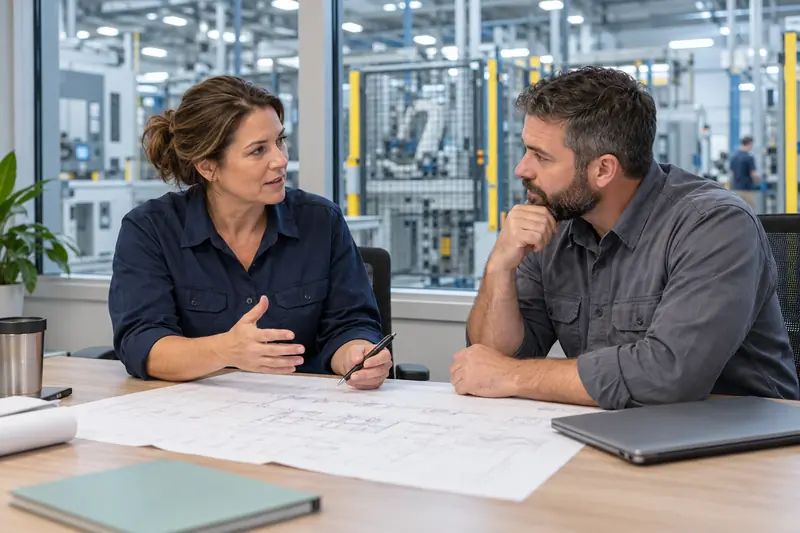
Illustrative recruiting and operations-planning scene.
A new plant may need experienced maintenance personnel, controls specialists, engineers, production supervisors, logistics leaders, and executive leadership before equipment is fully commissioned. Those early hires help establish safety, quality, and operating discipline.
Recruiting still requires qualification checks and onboarding. Previous experience does not automatically establish familiarity with your equipment, procedures, or production requirements.
- Define each role’s critical skills and required start date.
- Test candidate experience against the actual work.
- Align offers, relocation, onboarding, and training with the launch schedule.
Time to fill
Allow for sourcing, interviews, acceptance, notice periods, and onboarding.
Competitive offers
Evaluate wages, shifts, benefits, commuting, and competing employers together.
Operating continuity
Plan coverage for critical roles and review turnover exposure after hiring.
Connect hiring milestones with the manufacturing expansion timeline.
THE LOCATION CHANGES THE WORKFORCE PLAN
Test six labor-market conditions before choosing a site
The lowest-wage market may not offer the strongest operating fit. A region can have a large population while lacking the maintenance, automation, controls, or quality skills a plant needs. Evaluate the workforce alongside infrastructure, logistics, incentives, and facility readiness.
01 · Role-level labor supply
Define the occupations, headcount, skills, shifts, and growth phases needed. Regional employment totals alone cannot establish a workable hiring plan.
Read manufacturing workforce analysis
02 · Wages & competition
Identify employers competing for the same technicians, engineers, and supervisors. Test compensation expectations and the cost of attracting and retaining people.
Explore operating cost analysis
03 · Education & training capacity
Check relevant programs, curriculum, instructors, available places, and employer partnerships. Confirm the training can serve the plant’s technologies and schedule.
04 · Commuting & housing
Investigate the practical commute and housing options for local hires and transferred staff. A labor pool outside a workable commute may be difficult to reach.
See how housing affects site selection
05 · Relocation needs
Clarify which leaders or specialists may move, when they need to arrive, and the support required to establish the operation.
Read about executive relocation
06 · Hiring & production timing
Coordinate recruiting, training, construction, equipment installation, commissioning, and startup. Treat the workforce schedule as part of the expansion plan.
Use the manufacturing expansion checklist
For occupation-level employment and wages, use BLS Occupational Employment and Wage Statistics. Keep occupations, geography, definitions, and data periods consistent. These estimates support comparison; they do not show how many qualified people will accept your specific roles.
ONE MANUFACTURING TALENT PIPELINE
Run recruiting and skill development together
A blended plan connects immediate operating needs with the capability the plant must build over time. These phases are a planning framework; exact dates and program duration depend on the project and occupation.
01 · Before selecting the location
Recruiting focus
Define must-fill roles, skills, shifts, headcount, and target start dates. Test the labor market and relocation needs.
Development focus
Identify occupations suitable for development. Check mentor availability, education partners, and practical training capacity.
02 · Before the plant launch
Recruiting focus
Secure critical leaders and technical staff. Coordinate onboarding with equipment installation, commissioning, and operating readiness.
Development focus
Develop the training plan and partner arrangements early. Start learning only where suitable instruction, supervision, and resources are available.
03 · During ongoing operations
Recruiting focus
Review hiring results, turnover, compensation pressure, and replacement needs as the operation grows.
Development focus
Track skill progression and proficiency. Refine cohorts, curriculum, and mentor capacity around future production needs.
Keep the plan connected to incentives, training support, community partnerships, vendor resources, housing, relocation, and facility timing. Review eligibility and commitments before assuming support is available.
MEASURE THE PIPELINE YOU NEED
Compare costs and outcomes with clear definitions
Evaluate the full commitment of each approach. Recruiting can involve sourcing costs, compensation, onboarding, and relocation. Apprenticeships add planned learning, mentor time, instruction, wages, and program administration. The right mix depends on the launch deadline, role complexity, and available support.
| Measure | What to define and track |
|---|---|
| Qualified candidate flow | Candidates meeting the documented requirements, not only total applicants. |
| Time to fill | The interval from the agreed recruiting start point to an accepted hire or start date. |
| Time to proficiency | When the worker demonstrates the required tasks under the operation’s assessment standards. |
| Training capacity | Mentor availability, instructor capacity, learning resources, and protected time. |
| Completion & retention | The cohort, reporting period, completions, and workers remaining after a defined interval. |
| Total workforce cost | Compensation, recruiting effort, instruction, mentor time, onboarding, relocation, and replacement costs. |
A national apprenticeship outcome statistic does not predict results at a particular plant. Use project assumptions and your own defined measures to evaluate the workforce plan.
CHECK THE ASSUMPTIONS BEFORE COMMITTING
A practical workforce planning checklist
Launch requirements
- Which jobs must be filled before operations begin?
- What skills must a hire already demonstrate?
- Are wages, shifts, commutes, and relocation assumptions realistic?
- Have onboarding dates been aligned with commissioning and production?
Development capacity
- Which capabilities can be developed through a structured program?
- Who will mentor learners, and when is that time available?
- Which education or workforce partners can meet the actual needs?
- How will skill progression, proficiency, and retention be measured?
Document what is defined, what needs confirmation, and who owns the next action. The U.S. Site Selection Project Readiness Assessment can help bring the wider project requirements into one view.
WORKFORCE STRATEGY QUESTIONS
Apprenticeships vs. recruiting FAQs
What is the difference between manufacturing apprenticeships and recruiting?
Recruiting seeks people with relevant existing experience. Apprenticeships combine employment with structured skill development. Manufacturers can recruit apprentices as well as experienced staff, and a blended plan can serve immediate launch needs and longer-term capability.
Should manufacturers recruit experienced workers or train them?
Most projects need both. Recruit for roles where startup depends on proven experience, and develop skills where a supported learning pathway fits the schedule. The balance depends on role requirements, labor availability, training capacity, and the opening date.
What makes Registered Apprenticeship different from informal training?
Registered programs combine paid work, mentorship, related instruction, wage progression, and an industry credential. They are approved through the U.S. Department of Labor or a State Apprenticeship Agency. Informal workplace training does not automatically have those features or registered status.
How long does a manufacturing apprenticeship take?
Duration varies with the occupation, employer, industry, and program model. Confirm the applicable program requirements and proficiency expectations with the sponsor or apprenticeship authority. Use those details in the staffing schedule rather than assuming one standard duration.
What does an apprenticeship program require from an employer?
Plan for paid employment, qualified mentors, instruction, learning resources, skill assessment, and program administration. Verify the program’s requirements and budget the time and capacity needed to support workers as they develop.
What is a manufacturing talent pipeline?
It is the planned flow of people into the production, maintenance, technical, and leadership roles the operation needs. It can combine experienced recruiting, apprenticeships, education partners, workforce organizations, and internal development.
How does site selection affect recruiting and apprenticeships?
Location influences access to skills, competing employers, wages, training programs, commute patterns, and housing. Evaluate the specific jobs and timing the plant requires alongside infrastructure, logistics, costs, and other site requirements.
When should workforce planning begin for a new plant?
Begin before the location decision is final. Align hiring, instruction, mentoring, housing, relocation, construction, equipment installation, and production milestones so the labor plan reflects the operation’s schedule.
CONTINUE THE LOCATION AND WORKFORCE ANALYSIS
Related WorldPoint resources
Assess workforce quality
Move beyond headcount and examine the skills and conditions that affect operating performance.
How manufacturers measure workforce quality
Understand housing constraints
Connect workforce availability with practical housing and commuting considerations.
How housing affects manufacturing site selection
Compare locations consistently
Bring workforce priorities into a shared decision framework.
Manufacturing location scorecard
Build a workforce strategy that supports growth
WorldPoint Site Selection helps domestic and international manufacturers evaluate labor availability, recruiting conditions, training capacity, wages, housing, relocation, and workforce partnerships alongside the other factors that shape a location decision.
Connect workforce and location requirements
Bring the planned roles, launch dates, future growth, and training needs into the site selection brief. Evaluate how each candidate community can support that operating model.
When real estate brokerage services are needed, they are handled separately through CBREG True Team.
Choose a location that can support the people you need
Connect the opening date with the skills, hiring conditions, and training capacity needed to sustain production. WorldPoint can help bring those factors into a clearer location decision.