
DATA CENTER POWER STRATEGY
Why Power Availability Now Drives Data Center Site Selection
Begin the location search with a credible path to power. Establish what the site can receive, when it can be delivered, and which conditions control the result.
By Hunter Drinkall · Published September 9, 2026
Updated October 20, 2026
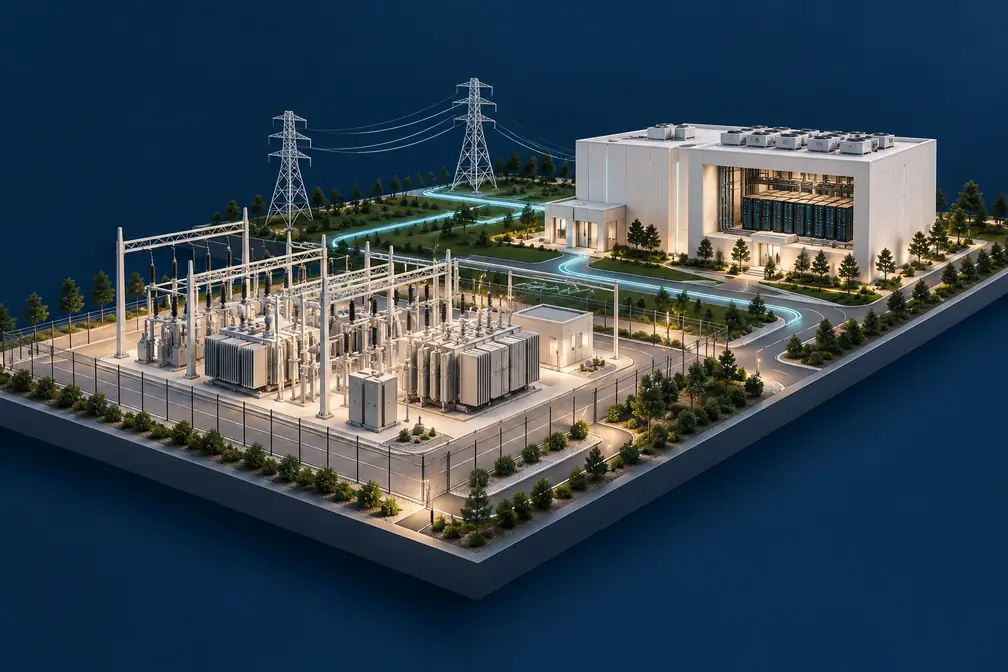
Conceptual illustration of a substation and data center. Not an actual client project or an electrical engineering design.
Power can determine which locations remain feasible
Data center power availability shapes the location decision because electrical service must support the proposed facility load, operating requirements, and deployment schedule. Suitable land, fiber, and incentives still need to be connected to a workable infrastructure plan.
The U.S. Energy Information Administration’s Annual Energy Outlook 2026 identifies data center load as a major factor in projected U.S. electricity growth. That national context makes early investigation useful; a specific site still needs its own utility review.
Capacity
Can the serving system supply the defined initial and future facility load under the proposed service conditions?
Delivery
What studies, works, agreements, and commissioning steps control when each phase can receive power?
Operating fit
Does the service path align with the facility’s reliability, commercial, and long-term growth requirements?
Define deliverable power for the actual project
A market-level capacity statement is a useful screening input. To advance a site, connect that statement to the project’s location, load profile, voltage requirements, phasing, and required dates. Make the assumptions visible in every utility response.
Site and connection
Identify the parcel, proposed connection point, serving infrastructure, and the facility assumptions included in the review.
Load and conditions
Confirm what load has been evaluated, how service would be provided, and what technical or operating conditions remain.
Evidence and status
Retain the response, date, responsible party, studies, assumptions, and outstanding conditions. Clarify the status of any commitment.
Keep the evidence status visible
An introductory discussion, feasibility response, engineering study, and executed service arrangement answer different questions. Record what each document supports and what must still be resolved before the next commitment.
Prepare one power profile before comparing locations
Give utilities a consistent operating brief. An engineer-validated demand basis is more useful than an unexplained megawatt target, especially when cooling, equipment density, redundancy, or future phases could change.
| Power-profile input | What to define |
|---|---|
| IT and total facility load | Separate computing demand from the full facility requirement, including cooling and other supporting loads. |
| Operating and peak conditions | Describe the ramp, operating profile, expected peak demand, and relevant coincident loads. |
| Electrical service requirements | Identify required voltage, power-quality needs, reliability objectives, and design assumptions. |
| Cooling and efficiency assumptions | Document the cooling concept and PUE assumptions; validate the service-demand calculations with engineers. |
| Initial and future phases | Show the capacity needed for commissioning, opening operations, later buildings, and credible growth scenarios. |
| Backup and on-site systems | Describe proposed generation, storage, testing, and operating interfaces that may affect the service review. |
MW: power and capacity
Megawatts describe a rate of power use or a level of power capacity. The utility review must establish the demand the project needs to serve.
MWh: energy over time
Megawatt-hours describe energy consumed over a period. Energy consumption helps evaluate operating costs, while capacity and peak demand need their own review.
Use the data center power-capacity guide to develop the project questions before requesting comparable site responses.
Turn speed to power into a delivery roadmap
Connect energization to commissioning and deployment milestones. Ask for the basis of each proposed date, the prerequisites still outstanding, and the person or organization responsible for resolving them.
Studies and decisions
Identify the applicable utility review, engineering inputs, agreements, and decision points. Record which later activities depend on the findings.
Equipment and works
Map substation, feeder, transmission, connection, and other required works. Link design, procurement, rights, approvals, and construction to the schedule.
Service and commissioning
Define the prerequisites for energization, testing, facility acceptance, and phased deployment. Review what changes if a dependency moves later.
A conditional target date should retain its conditions in the leadership summary. Avoid stripping away a study, access, equipment, or approval dependency when turning a utility response into the project schedule.
Identify who serves the parcel and controls the service path
Serving utility and interfaces
Confirm the provider for the specific parcel, its large-load process, and the relevant transmission and distribution interfaces. Nearby sites can depend on different providers or infrastructure.
Commercial and service conditions
Review the applicable rate structure, recurring charges, customer contributions, ownership, operating conditions, and agreements with the relevant utility and advisers. Compare the same load and evaluation assumptions across locations.
Keep the utility findings connected to location strategy, including land readiness, fiber, cooling, water, workforce, approvals, and logistics. A favorable rate needs to be evaluated within the full delivery and operating case.
Trace substation and transmission dependencies early
Substations and local connections
Ask whether the project needs dedicated, shared, new, or expanded infrastructure. Identify capacity findings, engineering scope, land, equipment, access, ownership, and construction responsibilities.
Wider system improvements
Identify any dependence on feeder, transmission, or other system upgrades. Ask which parties control the work, what approvals or rights are needed, and how the project date relates to the wider delivery plan.
Confirm the applicable connection process
Ask which load-service and interconnection procedures apply to the proposed project and any on-site systems. A generation queue position alone does not establish when the facility can receive its required utility service.
Use infrastructure planning to connect the works outside the parcel with the facility’s design and delivery assumptions.
Evaluate reliability alongside capacity
Capacity and service reliability address different operating questions. Coordinate the utility review with the facility’s electrical engineers and operations team so the location decision reflects the required level of resilience.
Service history and exposure
Request relevant outage, maintenance, and power-quality information. Review weather and other location exposures, while recognizing that historical performance does not guarantee future results.
Configuration and dependencies
Review feeder and transmission arrangements, available service options, and shared infrastructure. Confirm the actual independence of proposed supply paths with the appropriate technical teams.
Facility response
Connect utility service assumptions to backup generation, storage, electrical design, testing, maintenance, and operating procedures. Review the project-specific approvals and constraints affecting those systems.
Document residual risks and the decisions needed to address them. A large capacity figure should not conceal a reliability condition that is incompatible with the operating brief.
Test shared upgrades and future campus demand
Other loads and shared works
Ask how the utility’s planning assumptions, other committed loads, and shared infrastructure projects affect the proposed service path. Record the response date and what could change its validity. Announced projects alone do not establish capacity allocation.
Expansion and changing demand
Test later buildings, a faster ramp, higher density, and changes to cooling or other facility systems. Review peak-demand conditions and future works with the utility, and clarify what any capacity reservation actually covers.
The campus expansion planning guide connects future power with land, cooling, water, fiber, approvals, and construction sequencing. Give each phase its own evidence and delivery review.
Compare the evidence behind each capacity claim
Fictional example. The candidates below illustrate different evidence gaps. They are not actual sites, utility commitments, or a recommendation to select one candidate. Apply the same project brief before comparing their findings.
| Candidate | Evidence in hand | Unresolved condition | Next action |
|---|---|---|---|
| Site A | Market capacity statement and an introductory utility discussion. | The specific project load and delivery path have not been evaluated. | Request a project-specific screening response and identify required studies. |
| Site B | A feasibility response based on the proposed initial load. | Required upgrades, responsibilities, and delivery conditions remain open. | Confirm the scope, cost basis, ownership, and prerequisites behind the date. |
| Site C | A project response addressing initial service assumptions. | Later campus capacity has not been evaluated. | Develop the phased load review and keep future service assumptions conditional. |
A critical unknown needs a validation action before it can be treated as a pass. Retain the source, issue date, assumptions, owner, and next review date for every finding. Refresh the comparison when the project brief or utility conditions change.
Bring a clear power decision package to leadership
Summarize the feasible service path, the main tradeoffs, and the conditions that could change the decision. Keep unresolved items visible alongside costs and milestone dates.
| Decision input | Evidence to retain | Responsible team |
|---|---|---|
| Load and phasing | Current facility brief, demand basis, commissioning needs, and growth scenarios. | Project sponsor and engineers |
| Service path | Serving utility response, relevant studies, connection assumptions, and service conditions. | Utility lead and technical team |
| Works and delivery | Scope, responsibilities, ownership, procurement, rights, approvals, and milestone dependencies. | Infrastructure and delivery leads |
| Reliability | Configuration review, relevant service information, facility interfaces, and residual risks. | Electrical engineers and operations |
| Commercial case | Applicable charges, contributions, cost assumptions, timing exposure, and agreement review. | Finance, utility, and legal advisers |
| Open decisions | Outstanding conditions, responsible owners, due dates, and escalation points. | Project sponsor and workstream leads |
Use project management and collaboration to carry these conditions into delivery. The data center site cost guide explains how infrastructure and timing influence the wider location case.
Data center power availability: FAQs
What does data center power availability mean?
It means establishing whether the required facility load can be served at the specific site, under suitable service conditions, on a credible schedule. Evaluate capacity, voltage, required works, responsibilities, reliability, costs, and future phases together.
How much power does a data center need?
There is no universal requirement. Define IT load, total facility demand, cooling and auxiliary loads, peak conditions, operating profile, reliability objectives, and phased growth. Have the engineering team validate the demand basis used for the utility request.
Does a nearby substation mean power is available?
Proximity alone does not establish usable capacity, a suitable connection, required upgrades, service conditions, or delivery timing. Request a project-specific review from the serving utility and identify the evidence needed before relying on the proposed service path.
Why does speed to power affect site selection?
Power delivery can control commissioning and deployment. Studies, agreements, equipment procurement, rights, approvals, and construction may all influence the date. Compare the dependencies behind each milestone and show the conditions that could change it.
Do low electricity rates make a site the best choice?
Rates are one part of the comparison. Evaluate the applicable service structure, infrastructure contributions, recurring charges, delivery timing, operating conditions, and expansion needs. Use the same load assumptions and evaluation period across candidate locations.
Does sufficient capacity guarantee reliable service?
No. Review the utility configuration, outage and maintenance information, relevant hazards, power-quality requirements, and shared dependencies. Coordinate utility service with the facility’s electrical design, backup systems, testing, and operating procedures.
Can initial power service guarantee future campus capacity?
No. Later phases may require more studies, works, equipment, rights, or agreements. Record the basis and conditions of future-capacity assumptions, clarify any reservation arrangements, and refresh the review when the load profile or campus plan changes.
What should be verified before a site commitment?
Confirm the project load brief, serving utility, service path, studies, required works, responsibilities, timing assumptions, reliability considerations, commercial conditions, and future capacity. Give each unresolved item an owner and identify the decision that depends on it.
Turn power requirements into a clearer site decision
WorldPoint Site Selection helps data center and industrial teams connect utility capacity analysis with land evaluation, workforce research, incentives coordination, economic development discussions, relocation needs, vendor introductions, logistics, and operational planning.
Explore our site selection services or discuss the capacity, timing, and infrastructure questions behind your next U.S. project.
WorldPoint provides advisory support. Brokerage activities are handled separately through CBREG True Team.