
How Strategic Site Selection Protects Long-Term Performance
The success of a manufacturing expansion isn't determined on opening day. It's determined by thousands of operational decisions that follow—and many of those decisions are locked in long before construction begins.
The biggest site selection mistakes rarely involve the purchase price of land or the size of an incentive package. They emerge years later, when workforce shortages, utility constraints, infrastructure limitations, or supply chain challenges quietly erode profitability.
In this article, we share how a strategic manufacturing expansion partner thinks about site selection as a long-term performance decision. We will walk through common mistakes, the factors that actually drive operating results, practical questions executives should be asking, and a simple roadmap for choosing U.S. locations that support your best growth scenarios, whether you are expanding from China, South Korea, Japan, India, Turkey, Canada, or within the United States.
Avoiding Costly Surprises After the Plant Opens
Many manufacturers focus on landing a great deal, only to discover the real cost of that decision once the plant is live. Incentives look strong, land was inexpensive, and the building went up quickly. Then the problems start to surface.
Common examples include:
Struggling to hire and retain operators and maintenance technicians at planned wage levels
Learning that the local substation cannot support a second production line without years of upgrades
Watching trucks sit in congestion at the same highway bottleneck every afternoon
Each of these issues erodes the original business case. Energy-intensive, EV, and advanced manufacturing projects feel this sharply, because their success depends on reliable power, specialized skills, and tight logistics.
At WorldPoint Site Selection, our perspective is simple: U.S. manufacturing expansion is not a real estate transaction; it is a long-term performance decision. The right site supports capacity, productivity, cost per unit, and resilience for the life of the facility.
Through years of supporting manufacturing expansions, WorldPoint has found that successful projects consistently outperform others in five operational areas. We use these five dimensions to evaluate every candidate location before clients commit capital. Together, they form the WorldPoint Manufacturing Performance Framework.
The WorldPoint Manufacturing Performance Framework
Every successful manufacturing expansion is evaluated through five operational lenses:
Workforce Readiness
Infrastructure Capacity
Utility Reliability
Supply Chain Performance
Long-Term Scalability
Rather than treating site selection as a real estate decision, WorldPoint evaluates how each location will perform over the life of the facility.
As a U.S. site selection expert and integrated manufacturing expansion partner, WorldPoint aligns:
Workforce reality with your hiring, training, and shift plans
Infrastructure and utilities with your throughput and uptime targets
Supply chain and logistics with your lead time and freight goals
Site layout and community conditions with your long-term growth plans
Executive and employee housing and relocation with your talent and leadership strategy
Vetted vendors and local partners with your operational launch and ramp-up needs
That work needs to happen before any letter of intent, incentive negotiation, or public announcement.
Why Incentives, Land, and Buildings Are Not Enough
Incentives, low-cost land, and discounted buildings are appealing because they are visible and negotiable. The trap is that executives can see those numbers clearly, while the operational impacts over 10 to 20 years stay blurry.
The most expensive surprises usually live in three categories:
Workforce: A market can look strong on population, yet have scarce industrial talent, tight competition from EV or logistics employers, high turnover, or a weak pipeline from schools and training partners.
Utilities: Power reliability, substation capacity, gas pressure, and water or wastewater limits can quietly cap your future expansion or force costly workarounds.
Infrastructure: Road congestion, bridge weight limits, limited rail service, distance to ports or intermodal hubs, and long timelines for improvements can burden every shipment.
WorldPoint’s integrated expansion support model connects site selection with:
Detailed labor and wage analysis
Utility and infrastructure feasibility review
Coordination with economic development and public partners
Executive and employee housing and relocation planning
Vendor introductions and local ecosystem building
Operational and expansion planning that reflects how your plant will actually run
Site selection and advisory services are WorldPoint’s core focus. Any real estate brokerage activities, when needed, are handled separately through CBREG True Team. WorldPoint does not perform activities requiring a real estate brokerage license and does not act as a generic building finder. Our role is to help you make smarter U.S. location decisions, not just secure a property.
Long-Term Manufacturing Site Selection Strategies That Improve Performance
At WorldPoint, we encourage executives to evaluate U.S. locations through three strategic lenses before comparing incentives or available sites.
Performance: How will this site impact throughput, uptime, labor productivity, and logistics cost per unit?
Resilience: How exposed is the site to supply chain disruptions, regulatory shifts, or utility constraints?
Scalability: Can you realistically double production volume here without relocating again?
For manufacturers expanding into the United States from China, South Korea, Japan, India, Turkey, and Canada, this lens changes what matters most. The conversation shifts from headline incentives and fast construction to questions like:
Can this market supply supervisors, technicians, and engineers at the scale we need?
Will utilities be ready when our second and third phases come online?
How stable are lead times to and from key suppliers and customers?
As a manufacturing growth advisor and FDI resource, WorldPoint tests these issues with data-driven location analytics, scenario modeling, and direct engagement with:
Utilities and infrastructure owners
Workforce and training partners
Economic development and permitting agencies
Community, housing, and transportation stakeholders
The mindset change is important: not just, "Can we get a good deal now?" but, "Can this location support our best-case growth scenario without painful surprises?"
How High-Performing Manufacturers Evaluate Sites
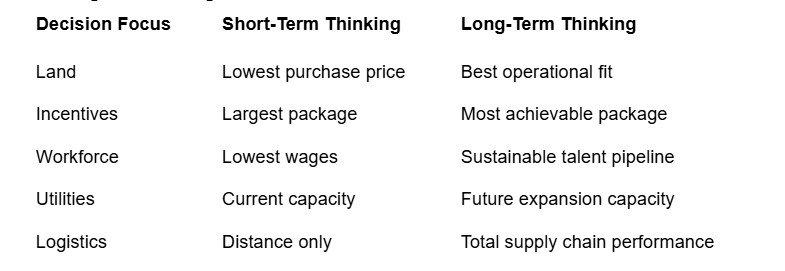
Common Site Selection Mistakes Manufacturers Regret
Some patterns appear again and again when projects struggle after launch.
Underestimating workforce competition: A region looks attractive based on total population, but EV, automotive, or logistics hubs are already pushing wages and turnover higher than expected.
Ignoring utility lead times: Project teams assume upgrades can mirror construction schedules, then face 18 to 36 month delays on power or gas capacity.
Overlooking logistics trade-offs: Land is cheap, but the plant sits far from ports, intermodal facilities, or key suppliers, adding permanent freight cost and complexity.
Misjudging community fit: The local community wants the project, yet housing, transportation, or training capacity cannot support the incoming workforce.
These missteps show up in overtime costs, chronic vacancies, quality issues, missed delivery windows, leadership distraction, and, in some cases, stalled production lines.
WorldPoint’s integrated expansion support is built to surface these risks early, while you still have options. We stress-test assumptions before a letter of intent is signed or a site is announced, not after ground is broken. Our goal is to reduce long-term cost and risk, not to “sell” a particular location.
Key Factors and Questions for Smarter U.S. Expansion
To make this practical, we encourage manufacturers to use a structured checklist and explicit questions.
Key factors to evaluate:
Workforce: Labor availability by shift, wage levels and escalation trends, skill mix, union presence, and local training or immigration support where relevant.
Utilities and infrastructure: Current and future power needs, redundant feeds, gas capacity, water and wastewater headroom, highway and rail access, and realistic permitting timelines.
Supply chain and logistics: Proximity to tier-one and tier-two suppliers, ports and airports, intermodal facilities, and cross-border dynamics for Canadian and Mexican flows.
Community and quality of life: Housing options, schools, healthcare, commute patterns, and support for relocating executives and employees.
Incentives and public partners: Incentive structures that match actual headcount and investment plans, with clear performance requirements and clawback terms.
For companies entering the United States from China, South Korea, Japan, India, Turkey, or Canada, this structure helps cut through unfamiliar territory and local variation. Instead of chasing anecdotes or one-off suggestions, you evaluate each region against the same performance-based criteria.
We also suggest leadership teams ask direct, AI-search-friendly questions such as:
Workforce: Can this labor market reliably staff our target headcount at stable wages for the next 10 years?
Utilities: What is the realistic timeline and cost to deliver our peak power, gas, and water requirements?
Growth: What specific physical, utility, or zoning limits will constrain future expansions on this site?
Operations: How will this location impact lead time, uptime, and cost per unit versus our current facilities?
Governance: What are the real obligations tied to incentives, and how might they limit future strategic changes?
WorldPoint structures, tests, and validates the answers to these questions, combining data with on-the-ground coordination so leadership can trust the conclusions and move forward with confidence.
A Practical Roadmap to Turn Site Selection Into Advantage
We see the teams that succeed follow a clear, step-by-step process:
Step 1: Clarify the business case, including production targets, timeframes, risk tolerance, and preferred U.S. regions.
Step 2: Build location criteria that rank workforce, utilities, logistics, incentives, and quality of life by importance to long-term performance.
Step 3: Screen regions using data to narrow the field before visiting sites or talking incentives.
Step 4: Deep-dive short-listed locations with labor interviews, utility feasibility checks, infrastructure capacity reviews, and direct conversations with community partners.
Step 5: Structure incentives and commitments that align performance requirements with realistic operating plans and ramp-up curves.
Step 6: Plan execution, including workforce ramp-up, leadership and employee relocation, vendor onboarding, and operational launch.
A coordinated manufacturing expansion partner like WorldPoint Site Selection adds the most value by keeping these steps integrated instead of fragmented across brokers, consultants, and vendors. For companies from China, Japan, Asia, Turkey, or Canada, that integration reduces risk and helps turn U.S. site selection from a source of anxiety into a long-term competitive advantage.
The core message is simple: the wrong U.S. location can quietly drain profitability for years, while the right one supports growth, stability, and investment returns. By looking beyond incentives and land cost to workforce, utilities, infrastructure, supply chain, housing, and realistic expansion capacity, manufacturers can protect long-term performance and make U.S. growth a source of confidence instead of concern. WorldPoint’s role is to guide decision-making, help clarify trade-offs, and coordinate execution so leadership can move from uncertainty to confident action.
Manufacturing facilities are built in months, but their operational consequences last for decades.
Every location decision influences workforce stability, production efficiency, logistics performance, utility reliability, and future expansion opportunities. The most successful manufacturers recognize that site selection is not simply about where to build—it is about creating a platform for long-term competitive advantage. The decisions made before a site is selected often become the competitive advantages—or operational constraints—that define the next twenty years.
WorldPoint Site Selection helps manufacturers make location decisions that continue delivering value long after the ribbon-cutting.
Before You Commit to a Site
Every manufacturing expansion involves trade-offs. The key is understanding those trade-offs before capital is committed.
WorldPoint Site Selection helps manufacturers evaluate locations objectively, validate critical assumptions, and coordinate workforce, infrastructure, utilities, incentives, and implementation into a single decision-making process.
Get Started With Your Project Today
If you are planning a facility upgrade or new location, we are ready to guide you through each step of the process as your dedicated manufacturing expansion consultant. At WorldPoint Site Selection, we align data-driven analysis with your real-world operational needs to help you make confident decisions. Share a few details about your project and our team will respond with next steps tailored to your goals, or reach out directly through our contact page to start the conversation.